

























Corporate Embroidery Embroidery Project
Embroiderers who apply the latest corporate looks to small business customers gain more business.
Materials
Project Preview Video

Cut Away Stabilizer - 2.5 Oz wt.

Cut Away Stabilizer - 2 oz wt.
The entry of new licensed names and the expansion of other high-end product lines is testimony to the attention manufacturers are giving the business of customizing garments for the identity apparel market. This interest is also shown by their attention to garment details. For example, some jacket makers now include hidden access zippers that allow embroiderers to place a hoop on the jacket and embroider without stitching through the lining. Some offer this for front embroidery only, while others allow embroidery on a full back location.
In companies of all sizes, women are prominent in today’s business world. It should come as no surprise that they don’t want to wear men’s clothing to work. Ladies sizes are now in most mid- to high-end wearable lines. As compared to men’s versions, the ladies’ counterpart in a particular style may differ in styling as well as sizing. For instance, a man’s twill shirt often features a button-down collar, while the ladies’ style has an open spread collar. Similarly, the man’s version may have a straight back yoke, and the ladies’ shirt a back locker patch treatment.
Application Tip: Women like their embroidery placements slightly higher than placements that men find acceptable on the front of pocketless shirts. When both men’s and ladies’ shirts will be used for an account, use a placement that is suitable for ladies, and match the men’s placement to the ladies. It is acceptable for men’s garments to have the higher ladies’ placement, yet the reverse is not acceptable.
Specialty sizing has also become more available. Recently, tall sizes and plus sizes have taken a more visible position, with some distributors specializing in big and tall sizes. Having a good working knowledge of the products available and a few sizing samples is an irreplaceable asset on a sales call. After all, if the owner wears a size four extra large, imagine his reaction to, “Let me check whether that color is available in your size,”
 Colors
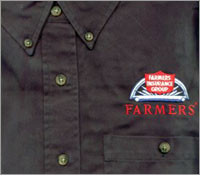
Fig. 1 shows the traditional colors of the Farmers Insurance Company. While it looks good on the printed page, the red white and blue color scheme can appear dated, and limits garment color choices.
Fig. 2 shows the same logo following the company’s new color guidelines. The new guidelines allow the logo to be rendered in two colors, with one color creating a negative space effect, by matching the garment color. The second color can be any color, often matching contrasting trim on the garment.
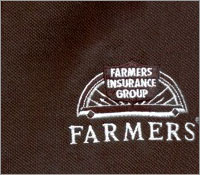 This simple modification may also be recommended to your smaller business customers. Philosophies vary on this point, but many companies find it acceptable and even desirable to vary the color schemes in their business identity apparel.
Another recommendation that you can make to companies, particularly those that use trade show apparel, is regarding a popular new embroidery placement. On twill, denim or other woven shirts, the back yoke is a perfect showcase for a company’s web address. Similarly, the locker patch of knit shirts can be used for a web address or company slogan.
Fabrics
This is possibly the most innovative and exciting area of wearables, with a couple of notable developments.
Teflon®-coated Fabrics
Recently introduced garments made with Teflon®-coated fabrics are gaining popularity. Their resistance to liquid and other stains makes them a favorite among service industries such as restaurants. The coating doesn’t affect the application of embroidery, and normal application methods may be used. Garments made of the coated fabrics include golf style knit shirts as well as twill styles.
Application Tip: For best results, use a light ball point needle on golf styles made from knitted fabric, while a sharp needle will give better clarity on small lettering and details on woven twill styles. Water-soluble topping may be needed on either fabric type to attain clean, crisp small letters.
Some blank shirts contain a small amount of Lycra® for comfort, a blend that is also presently popular in retail settings. Because this fabric stretches, some embroiderers find it challenging to embroider. One method to tame the stretchy stuff is to adhere a piece of lightweight, fusible cutaway stabilizer. Because of the Lycra content, the fusible should bond at low temperatures to prevent damage to the fabric. The cutaway stabilizer will prevent stretching and shifting of the fabric during the embroidery process.
Programming
Proper interpretation and programming of logos is possibly the most important avenues to success in corporate embroidery.
Lettering
Small lettering is a common element in corporate logos, and at times, it may be necessary to set down guidelines for your customers. To make lettering readable in embroidery, there may be changes that must be made from print versions. Lettering with very narrow columns may need to be thickened, long lines of lettering may need to be abbreviated or stacked on multiple lines, and lettering styles may need to be simplified to be more readable in very small sizes. If you aren’t well-experienced with digitizing small lettering, rely on the recommendations of a professional digitizer and pass the recommendations along to your customers. Small lettering has relatively few stitches, so don’t try to economize by using stock lettering when it would stitch more cleanly and crisply if it were specially digitized.
Simplification
Because printing can achieve finer lines than embroidery, some logos must be translated into embroidery. Color blending and fine lines may require modification to present the best embroidered representation of the logo. The guideline to remember here is to simplify only as much as necessary. Oversimplification that changes the fundamental appearance of the logo affects the recognition factor.
