
























Singles, Anyone? Embroidery Project
Just in case you're thinking of a single head, and don't have a special brand of embroidery machine that you love best, I checked out the major brands to see what's what.
Materials
Project Preview Video

Cut Away Stabilizer - 2.5 Oz wt.

Cut Away Stabilizer - 2 oz wt.
You might ask if there's life up here. Why, sure there is! There are ducks and geese, deer, moose, bear, wolves and an occasional elk. Every now and then you even see another person! It's probably a hunter, and because Minnesotans are friendly by nature, we'll strike up a conversation, and I'll sell him a cap or ten, which I would be happy to stitch for him on my single head embroidery equipment. In my situation, I can't imagine having other than single head units.
Oh, that's not an entirely true statement. There are those orders that I wish I could hoop up six or twelve at a time, like "seed caps," (those are the ones that the grain elevators order in the spring,) but most often, I am happy to contract orders of that magnitude with another company. I like those orders a lot. We take the call, place the order, drop ship the caps or garments, get the finished product from UPS, open the boxes to see that the work is satisfactory, type and print the invoice, call the customer back to pick up the product and collect the check.
I am a single head advocate, as you can tell, and I come by it naturally. As many beginning embroiderers do, we started with one single head in a brand new business. As the business grew, we hired a machine operator, and pretty soon were running that single head twenty-four hours a day. Then we decided we could handle more than one machine at a time, and got a second single head. Back in 1990, when I started embroidering, multi-heads cost a lot more than they do now, and we didn't really even consider getting a multi-head because it was cost-prohibitive. Single heads cost more then, too. We could buy two and a half machines now for what we paid for that first one!
As luck would have it, one of our best customers started a snowmobile race circuit, and since we were already embroidering his company clothing, we were a shoe-in to do the circuit clothing. Over the course of time, this led to the development of a line of race wear, consisting mainly of custom designed team jackets and crew shirts. The natural progression led to the investment of three more single heads, making a grand total of five, the number we settled with.
Why five? There are five main parts to these garments; two fronts, two sleeves and a back. Why single heads instead of a multi-head or two? Most race teams are small. Therefore the orders are small. Usually it starts with one sample jacket, which is some wild and crazy design we allowed the customer to dream up. We would have to do one to make sure that all the pattern pieces fit, and that the color scheme was correct, and that what looked great on the drawing board looked just as terrific on the body. After that, the team, which is typically four or five people, would order their garments. When the team hit the track, the fans would start clamoring for fan clothing, too. Because the clothing is custom-made, we are working on the panel program and we can spread one garment over five machines.
If you haven't embroidered race clothing yourself, you've all seen it on ESPN. It's embroidered everywhere! Having single head embroidery equipment gives our shop the flexibility to be running all those designs at one time. Invariably, some designs are shorter than others, and that's when we fill the machine with other orders.
We do more small runs than large, mostly because of where we live, but also because of our acceptance policy. We don't turn the small orders away. Another factor for me is my digitizing and design business. We stitch out thousands of designs one time only for proofing and photography. If we had multi-head equipment, we would have a lot of heads shut off most of the time.
The point is, you have to look at everything. Population is definitely a factor in determining what the initial investment should be. Your marketing plan is another aspect. If the plan is to sell corporate apparel, a multi-head will likely be a better deal for you. As with the race clothing, niche marketing could be a reason for selecting single heads. Or, if the niche leads to vast amounts of production of one or a few items, the multi-head might be the better choice. If you have a store front, and will be accepting onesie-twosey orders frequently, the natural choice would be a single head. If you're a digitizer and not selling embroidered products, you will only need one sewing head.
The advantages of running single heads are many. First of all, if there is a thread break, or machine maintenance is scheduled, only one head is stopped. The rest remain running. Second, a single embroiderer can run different designs on each machine, all at one time. Also, all machines do not have to stop for thread change-overs, just one at a time. Production keeps right on moving through that process. Changing from caps to flats, or vice-versa, is an easier process, also one at a time so the rest keep stitching away.
I can't imagine an embroidery shop without at least one single head. I know they exist, but I'm just glad it's not me! What do they do for embroidering names, shut off five heads or eleven heads? I guess so!
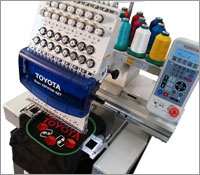
The Elite XL, the smaller version, has 9 needles, a sewing field of 250mm X 400mm, and sews up to 1200 spm. It, too, has cap and tubular capabilities.
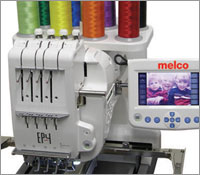 Melco
MelcoMelco's portable 4-needle machine is the EP4. It looks a little like a sewing machine, but has an embroidery field of 9.5" by 5.5". It is compatible with Melco's DesignShop software.
Melco's latest claim to fame is the Amaya and the brand new Amaya BRAVO. This 16 needle machine has a laser eye, an adjustable presser foot and automatic thread tensioning. It stitches up to 1500 spm and can be networked in single or multi-head configurations. Its maximum sewing field is 19.7" by 16.9".
Three industrial single head machines are offered by Brother International. The 1-needle is a newly-developed machine, with many of the same features as the 9-needle and 12-needle machines. The single-needle is operated by a disk drive with editing functions, as are the other two. The nine and twelve-needle machines can be networked, however. All have a maximum sewing field of 450mm by 300mm, a double capacity rotary hook, thread trimmers, and a centralized lubrication system. Tubular, flat and wide cap options are standard.
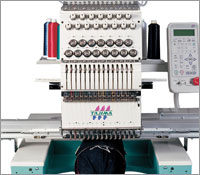 Hirsch International Corporation - Tajima
The single head Tajima has 15 needles, a 14" x 20.5" sewing field, and stitches up to 1200 spm. The machine comes mounted on its own drop table. It is an arm type tubular/cylindrical frame machine and comes standard with the wide cap frame unit. Optional cylindrical frames are available for purchase.
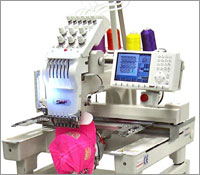 SWF
SWF