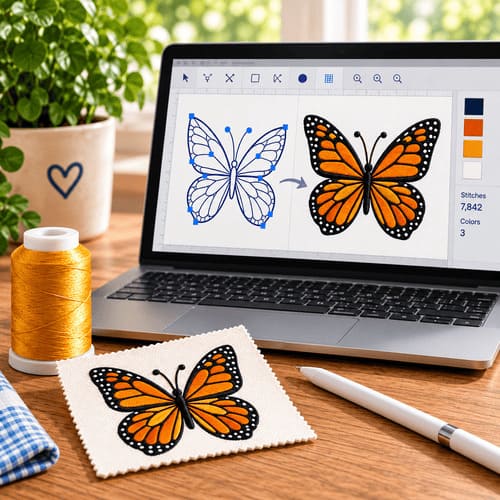
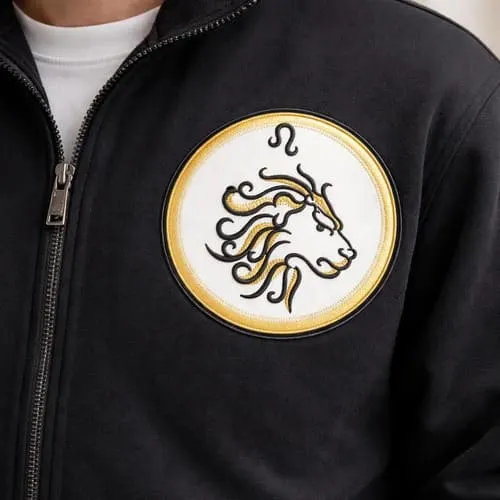
Border OptionsHugging border, circle, square, or rectangle — with a 3mm satin stitch.
Backing OptionsAvailable with iron-on, sew-on, or velcro backing.
Fast ShippingShipped quickly from the USA.
Free Online Tools
Powerful embroidery utilities that save time and prevent costly mistakes.
Stitch AssistantRECOMMENDED
Get the exact stabilizer, machine settings, needle, and thread color sequence for every embroidery design you purchase — based on that design's stitch density, dimensions, and color count.
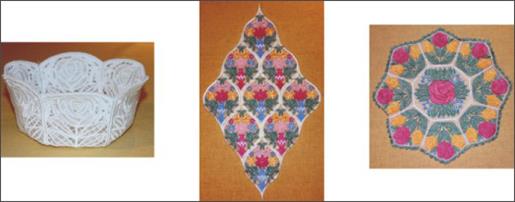
Have you ever seen a lace design and thought, "I love that design but what can I do with it what can I embroider it on?" In this tutorial we are going to teach you how to embroider a lace, how to apply lace to a project and how to take care of lace.
There are two different types of lace available on the market. The first type is free standing lace
which means that you embroider the design on water soluble topping or
iron away stabilizer and when the design is finished sewing all that
remains is the lace. In order for the design to stand by itself it needs
to be digitized a certain way or it will unravel. Only designs that
indicate free standing lace can be used this way. If the design doesn't
indicate free standing, it may fall apart when the stabilizer is
removed. Of course, if you choose not to do it free standing, you can
sew this type of lace on anything you like including organza or finished
garments.
The second type of lace is non free standing lace
or look alike lace. This is just a standard embroidery design made to
look like lace without having the important characteristics needed to
keep the finished product held together. These designs have an heirloom,
open type of appearance and can be equally as beautiful, but need to be
used in a different way.
Have you ever seen a lace design and
thought, "I love that design but what can I do with it or what can I
embroider it on?" In this tutorial we are going to teach you how to
embroider lace, how to apply lace to a project and how to take care of
lace.
Embroidering Lace
The
first step in embroidering successful lace is choosing the proper
stabilizer. There are a few different stabilizers on the market which
work really well. Essentially there are two types available that can be
removed after embroidering. One is an iron type, and the other will
disolve away in water. Water soluble topping is available in different
weights. If what you have is very thin, you may need to use three od
four sheets of it. There are a number of brands on the market that are
single layers of a heavier weight such as "Badgemaster". This type of
water soluble stabilizer is somewhat clear, like a plastic bag. There
are also wash away brands that are white and have a texture similar to a
paper towel. When this type is immersed in water, it falls apart like
bathroom tissue.
The second type of stabilizer is designed to
dissipate when hit with an iron. One brand is called "Miracle film" and
it comes in different thicknesses like water soluble. We prefer the
thicker type because it can handle more thread without perforating or
warping. "Miracle film" irons away so it is much durable than water
soluble. It does not harm your iron. Test the different types to see
which is your preference. Water soluble sometimes has to be soaked for
quite a while to remove the stiffness completely, but it could be what
is needed if you are doing more sculptural lace projects such as bowls.
At Anita Goodesign we always recommend asking your local sewing machine
dealer for their guidance when doing a new embroidery project with
unfamiliar products.
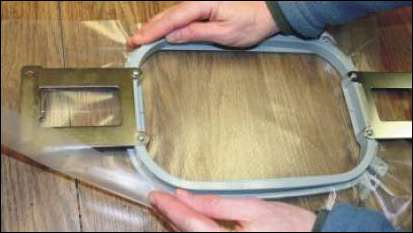
Step 1:
This example shows one piece of "iron away" stabilizer being hooped.
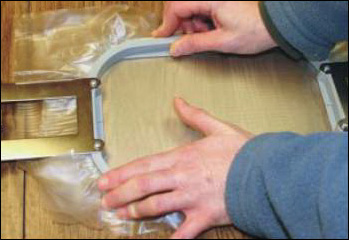
Step 2:
(Click Image to Enlarge)
This example shows four pieces of water soluble stabilizer being hooped.
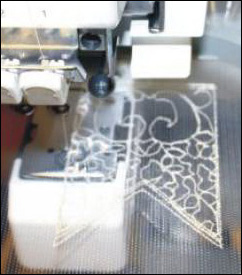
Step 3:
(Click Image to Enlarge)
This is what the lace will look like when it is sewing on your
embroidery machine. We suggest running the lace at approximately 500-600
stitches per minute.
Step 4:
(Click Image to Enlarge)
If you see holes start to appear in the lace you need to use more
stabilizer. The thicker or larger and more involved the lace is, the
more stabilizer you will need.
Steve Wilson is co-owner of Anita Goodesign, a company serving the home embroidery enthusiast. He is also owner of Artbox Digitizing Studio and the co-owner of Art-Sew-Perfect stock design company. Steve has won over 20 digitizing awards, written over 70 articles on digitizing and embroidery techniques and has produced 18 digitizing "How-To" videos. He has also digitized thousands of designs for the home textile and decorating industries and is bringing that experience and expertise to the Anita Goodesign Home Decor Collections