



























Getting It Right! Digitizers Communicating with Customers Embroidery Project
How can we solve that problem of communication? There’s an easy answer. Get yourself a basic order form.
Materials
Project Preview Video

Cut Away Stabilizer - 2.5 Oz wt.

Cut Away Stabilizer - 2 oz wt.
 At first, we think we will remember everything. But the more we do, the more jobs we take on, the less ability our brains have for holding all of that information. So, for embroidery, we have order forms. Those forms hold a wealth of information, from the type of garment the customer wants, to the company and catalog from which the garment will be ordered, to the sizes they want, to the design they want placed on the garment, to the area on which they want the design placed, to the size of the design, to the colors and the type of thread that will be used. The order form covers every aspect of the garment and the embroidery that will be placed upon it.
Why is it, then, that digitizers don’t often take the same trouble to get it right? I find myself as guilty as the next person when it comes to getting the details of digitizing down in black and white, or the lack thereof! I’m guilty of assuming that I know what the customer wants AND what is best.
We hear embroiderers complaining about digitizing and the digitizers who create the designs all the time. As digitizers, you would think that we would want to solve the problem.
Part of the problem is that now that most designs come to us via email, we have less verbal contact with our customers than we used to. We were more likely to pick up a telephone to clarify details about a design than came in via fax or snail mail. While artwork is, for the most part, much better today than it ever has been, there were advantages to having those conversations because they brought out communication.
Webster defines communication as, “A process by which information is exchanged between individuals through a common system of symbols, signs or behavior. Also, exchange of information.” This is just one of several definitions given in the Merriam Webster’s Collegiate Dictionary. It sounds so simple, yet most of the world’s problems can be chalked up to a lack of communication.
When I first started digitizing, I only accepted jobs for in-house customers. Working with a customer face-to-face is, in many ways, easier than working with a client long distance. The simple fact that he can hand you the artwork, and you can accept or reject it on the spot, explain in detail what you require to make the design perform successfully on the embroidery machine, and judge that person’s reaction, knowing he understands, makes for more effective communication.
Once I started accepting outside assignments, I quickly learned the importance of detailed communication. In my early years of digitizing, getting proper artwork was usually only achieved through snail mail. If a customer was in a hurry, the fax machine was the only way to transport the picture quickly. When I recall the artwork I used to accept, I just cringe! Poor faxes and black and white photocopies when the customer wanted color are just a couple of examples of the inferior artwork digitizers used to put up with. Business owners today wouldn’t consider running an office with the sordid lack of equipment that was a fact of life not so many years ago. Those examples of poor art, though, led to great communication.
The internet has played a major role in making the life of a digitizer easier. We no longer have to accept inferior artwork. Scanning a color photograph or logo is a simple process, taking only seconds. The customer can select the quality and the format in which he wants to save the artwork and an effortless attachment to an e-mail places the art almost immediately into the digitizer’s virtual mailbox. Many customers have the capability of sending vectorized art, better yet for those who digitize on-screen.
Why then, do digitizing problems still exist? I contend that there still is a serious lack of communication between the customer and the digitizer. How can we solve that problem of communication? There’s an easy answer. Get yourself a basic form that covers all of the details that a digitizer would have to know to do the job right. Whether you are a digitizer doing a job for a customer or the customer seeking a design from a digitizer, the answers to the questions are important.
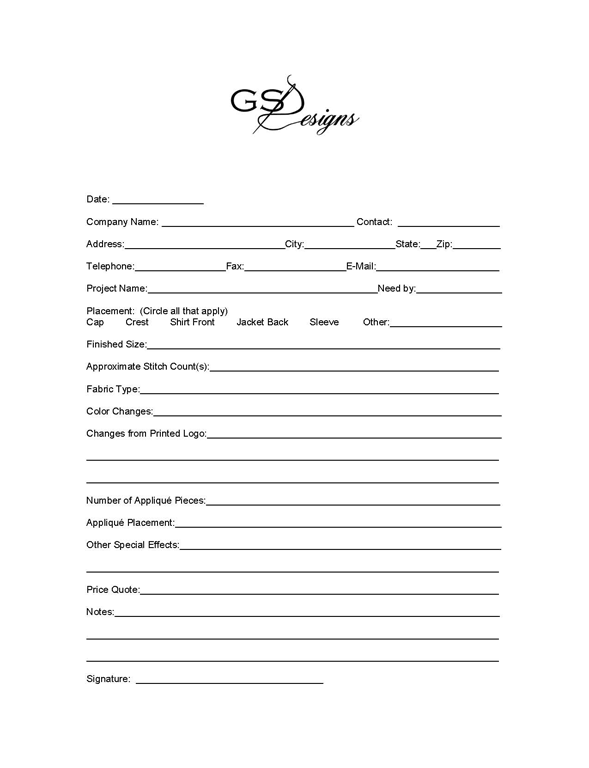 The order form to the right (click to enlarge) starts out with basic information that is needed from any customer; their name, address and contact info. In this deadline oriented business, the next line is all-important. For the most part, I believe that orders for both embroidery and digitizing should be completed in the order in which they came in, but sometimes deadlines can be shuffled to satisfy all customers. You just don’t want to miss one!
The next line contains the information that I always forget to ask about, especially when communicating on-line. “How big is this logo going to be?” One of the most important questions, and most embroiderers forget to tell the digitizer and many digitizers forget to ask! And it’s such an important question! How much detail can be corporated into the design is directly related to the size.
The next question is also very important. It determines exactly how the digitizer will go about creating the design. What type of garment or substrate on which the logo will be placed? Digitizing for caps is different than digitizing for crests, even though the logo might be the same size. If the product is knit, more underlay may be required than if the item is woven. Leather might require less density, and underlay that would not show through the fills. Those are just a few examples of why it is important for the digitizer to know the substrate.
Particularly if the design is being created for a customer without editing capabilities, it is imperative that the digitizer create the design for the specific type of fabric because the customer will not have the advantage of being able to make changes for themselves.
The number of color changes is important. In our shop, we do not charge extra for color changes, but some shops do. Many logos that are created in the sophisticated graphics programs of today have colors that the customer may not want to pay for, such as blended fill areas. Or perhaps the customer might just want the logo to look different than the printed logo. At any rate, getting the number of colors down is essential.
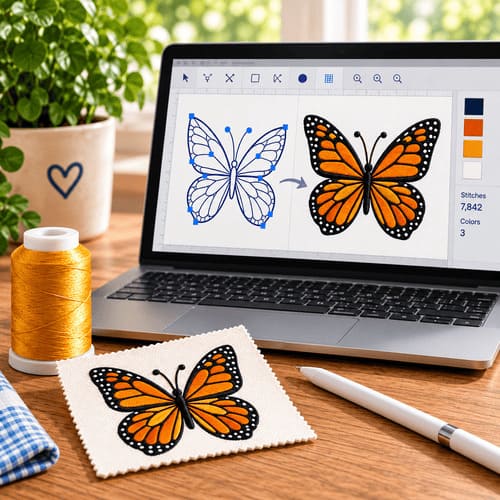
Changes are often necessary when going from print to thread. In print, the artist is capable of using very small designs and letters, blending inks, and extreme detail. Since thread is much thicker than ink, many of those things may not be “embroider-able.”
What many customers fail to realize, when looking at any given piece of artwork, is that thread has a thickness that does not allow for the same fine detail as ink. That is not to say that thread is not an effective means of reproduction. It is merely different, and must be treated as such. It is the job of the digitizer to explain and make the customer understand what is and what is not feasible with thread. All too often, the customer will insist on a highly detailed design, only to be unhappy with the outcome. Detail adds stitches, resulting in higher embroidery costs, sometimes to the point that the embroidery machine will not perform at its maximum efficiency. Multitude thread breaks caused by too much detail cause loss of production and frustration for the embroiderer, and an inferior design for the customer. Lettering that is too small to be readable when reproduced in stitches might be best left undone or changed to a text style that will work. The question that needs to be posed is, “How much of the design will be digitized?”
Special effects can be many things from appliqué to metallic threads to special techniques involving fringe, etc. It can also be a combination of printing and embroidery. A happy customer is one who knows all of his options. Chances are most business owners will opt for their logo, plain and simple, but there are those who are more adventurous.
No matter how good your order form is, sometimes there are extra notes that need to be taken. A section for that is the last thing on this order, with the exception of the signature. The signature…very important! Over the eighteen years that I have been embroidering, then digitizing, then custom digitizing, then owning and operating a stock design company, then teaching at trade shows, one of the stories that I have heard the most often is about miscommunication, which always results in either the embroiderer, the digitizer or the customer going away unhappy. A signature on an order form is merely an acknowledgement of what the discussion has been, and it is protection for both the customer and the digitizer, or embroiderer, whichever the case may be.
There you have it. This is a form that has been working for us for many years. It covers all the bases of digitizing. Feel free to beg, borrow or steal it, or any of the ideas it contains.
