
































Heading in the Right Direction Embroidery Project
What is the best machine for your business?
Materials
Project Preview Video

Cut Away Stabilizer - 2.5 Oz wt.

Cut Away Stabilizer - 2 oz wt.
The answer is that there is no real answer. Because each embroidery business is different, the production requirements will vary significantly from shop-to-shop and it’s that criteria that will define the right machine or combination of machines needed to produce your orders efficiently and profitably.
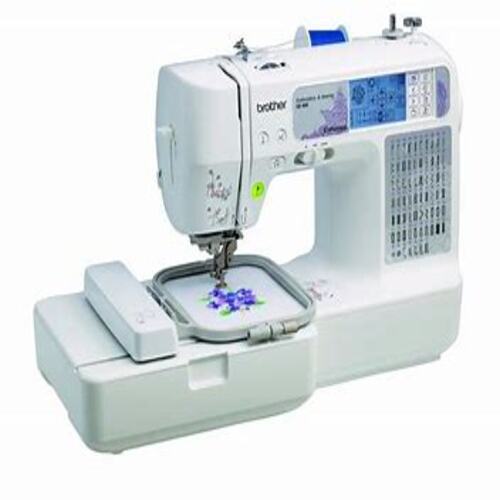
The majority of new Embroiderers start with a single head and move on from there. Though sewing quality and operational features vary from brand-to-brand, the typical single head can handle a wide variety of garments including caps, shirts, jackets, aprons, and so forth. And when outfitted with specialty attachments, the repertoire of products expands to include CD cases, golf club head covers, wine bags, shirt pockets, pants legs, pet collars, etc. Additionally, single head machines can usually sew at higher speeds better than multi-heads. And of course, the small size and simple power requirements make these machines ideal for home-based operations. But probably the single most common reason for purchasing a single head machine is the cost.
Since most new Shop Owners have reservations as to how successful they will be, they have a tendency to look for ways to enter the industry with the lowest investment possible. There is nothing wrong with this line of thinking, as long as the machine of choice does what is needed in order to bring in the revenue required to operate their business. But buying the wrong equipment, no matter how low the price, may severely impact the ability to provide the products and services needed to make a legitimate profit.
Bottom-line, a machine’s capability needs to be matched to a business’s requirements.
To get a better idea of the true production differences between different head configurations, we must perform some calculations.
For purposes of discussion, assume that the average sewing job has 7500 stitches and 6 colors. Running at a speed of 800 spm, and taking into account speed variations, trims, color changes, etc. the sew time will work out to about 13 minutes. Removing a finished hooped garment from the machine and replacing it with a new one, will add another minute or two, so assume about 15 minutes for each run.
 Initially, it would seem that a single head machine would produce 4 pieces per hour, a two head machine 8 pieces, a four head machine 16 pieces, a six head 24 pieces, etc. But that’s only when you are running the same job over and over again. In reality, a certain amount of downtime is incurred every time a new job has to be setup. Such downtime includes changing out cones of thread, loading a design, programming needle sequences, changing the pantograph from tubular to caps, etc. The more heads, the longer the potential downtime. Thus, it may not be economical to use a multi-head machine for small runs, as you can spend more time setting up the machine than actually sewing.
Now assume that your average order is twelve pieces, the sew time would look roughly like this:
Two Head 90 minutes (1 ½ hours)
Four Head 45 minutes
Now add in setup time, based on ten minutes per head:
Two Head 20 minutes
The total production times now looks like this:
Two Head 110 minutes
Every machine has a point of maximum efficiency, which is based on the machine’s capabilities as well as the parameters of the job. In the chart below, it’s assumed that a single head machine is being used and that every job is roughly the same in regards to run time. In addition, it’s assumed that the machine operator spends fifteen minutes to get each job setup and running.
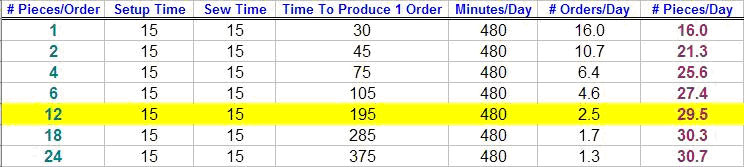
(Click Image to Enlarge)
NOTE: The point of maximum efficiency varies based on setup time and run time. All jobs are not created equally!
As machines increase in size (number of heads) the point of maximum efficiency increases as well, such that it is cheaper to do a large order on a large machine, than it is to do the same order on a small machine. Thus, as your average order size increases, you will probably need to consider a larger machine in order to get each job produced quicker and cheaper, in order to stay competitive.
As your average order size increase, it might seem logical that you should trade in your smaller machine on a larger model. But just buying a larger machine may not be the right solution, as there is another angle to consider: how many jobs need to be produced simultaneously?
It’s rare that your jobs actually arrive in a nice neat sequence, such that delivery times can be staggered over a large period of time. It’s much more common to have multiple jobs due at the same time. While buying a larger machine increases your overall production capacity, it doesn’t necessarily improve your ability to deliver, because it still only lets you sew one order at a time, when in many cases you need to be able to produce several orders at the same time.
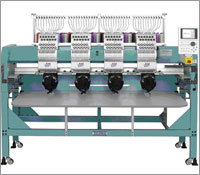 Thus, if you were considering a four head machine, you should also look at the concept of a pair of two-head machines or maybe even four single head machines. Having multiple machines onsite gives you much more versatility as you can produce more than one order at the same time or run the same order on all machines at the same time. Think about it, with four single heads, you have the following production combinations:
(1) single and (1) three head
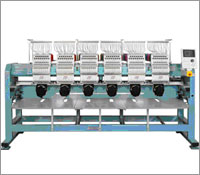 Being that most manufacturers, such as Tajima, offer the ability to network multiple machines together, you can get very creative how you setup your machines. But with single heads, there are certain limits. Production studies have shown that in most situations one person can only manage three single heads effectively at the same time. Thus, if you invested in six single heads, you might need two operators in situations where you are running all or most of them on separate jobs. In comparison, one person can easily manage a six head machine alone.
So, what is the best machine for you? It all about how your orders breakdown and what is the most effective setup to manage your workload while providing flexibility and versatility. But if you are a growing shop, then you will find that typically two heads (or more) really are better than one…
