




































Digitizing: Are You Sure You're Ready For It? Embroidery Project
One of the most frequently asked questions I get from new embroidery business owners is, “Should I purchase a digitizing system when I buy my machine?”
Materials
Project Preview Video

Cut Away Stabilizer - 2.5 Oz wt.

Cut Away Stabilizer - 2 oz wt.
One of the most frequently asked questions I get from new embroidery business owners is, “Should I purchase a digitizing system when I buy my machine?”
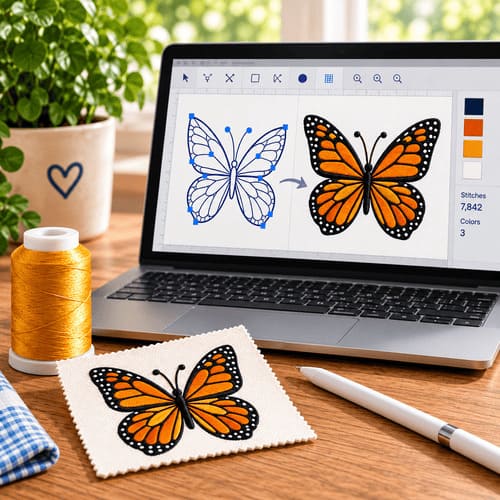
That is an excellent question and one that takes some thought. Digitizing is a big step and you should understand what is involved with the process before you make your final decision. Focusing on it too soon can be a costly mistake. To begin with, embroidery digitizing is a complex task. There is much more involved than simply scanning a design and pushing a few buttons. While most software systems have greatly simplified the operational process of digitizing, there is still a lot of theoretical knowledge required in order to create designs that look good and sew great. For example, you need to be familiar with the different types of stitches and how to use them. You need to understand stitch length, stitch density, push/pull compensation, column widths, underlay etc., and how all of these variables interact. It takes training, knowledge, and practice to master the art of digitizing - and it doesn’t happen overnight. If you are new to the field of embroidery, you may want to concentrate on learning the sewing (and selling) end of the business first and worry about digitizing later. If you choose this course, there are several things you can do to prepare yourself for adding digitizing capabilities in the future. The first and foremost step is to analyze designs as they sew. Look at the various stitch types and see how they are used. Observe the effect of different stitch directions. How is texture achieved? Does the design have a nice three-dimensional look, or does it appear flat and dull? Are there excessive thread trims? Are there too many color changes? Do the outlines line up? How would you make it better? Try and determine what it is that brings a great design to life. While you’re at it, try and see what it is that makes a bad design bad. By familiarizing yourself with design characteristics, you will go a long way in preparing yourself for digitizing. The next thing you should do is read all you can about the subject. Every month, there are informative magazine articles written by expert digitizers. Read the articles carefully and make sure you understand the content. But realize that since no two punchers digitize exactly the same way, you will probably encounter several different solutions to any given problem. With this exposure to multiple viewpoints, you can gain quite a bit of insight into the details required to produce quality designs. Use this information to begin visualizing some of the techniques required for professional digitizing. As you watch your machine sew, refer back to these articles to help with design analysis. |
The third method of introducing yourself to digitizing basics is to attend industry seminars. As with magazine articles, seminars typically are taught by industry experts with an abundance of knowledge and experience. In this type of environment, the speaker can show you step by step how he/she accomplishes a given task. And of course, you can ask questions about things you don’t understand. Even if you don’t yet have a digitizing system, you can pick up quite a bit of useful information. (Be sure to note whether a digitizing seminar is software specific or not.) In addition, you usually have the chance to get a hands-on perspective of what it really takes to digitize a design. Use this experience to gain an understanding of what software features are available and how they work. Finally, if your software allows it, add editing capabilities before you consider digitizing. My software (Tajima DG/ML By Pulse) was designed so that I could gradually add features as needed. First I bought the lowest level, which allowed me to learn basic techniques such as setting up lettering and merging designs. Then I added editing, which gave me the ability to modify existing designs and fonts. (This was a very important step since editing is most definitely a prerequisite to digitizing.) Finally, I made the leap up to digitizing, which was relatively simple because I had spent a year mastering the aspects of editing. Of course, it still took many weeks of digitizing practice to come up to a decent level of proficiency, but I do feel that all of the preparation really paid off. |

To sum it all up, you have two investments to make when you add digitizing to your business. The first is the cost of the software (as well as any hardware necessary to support it), and the second is your time. If you are a one person shop, that means you have to do everything, and digitizing time will take away from sewing and selling time. Selling is obviously the most important aspect of running a successful embroidery operation. Until you have a decent customer base producing a positive income stream, the selling should be your main focus. But as your business grows and things fall into a rhythm, the digitizing aspect may become a more realistic option than in the very beginning. With this in mind, you may want to go ahead and purchase a digitizing system when you start your business (as you may be able to get a really good package price), but keep your aspirations and expectations firmly in check and focus on developing your embroidery and business skills first. Then, move up to digitizing when the time is right. And when you do take on digitizing, be patient. Stick with simple designs at first and send the more complex ones to your regular Punch House. Know your limits - just because you have the equipment doesn’t mean you have the ability. If it takes you two days to make a design sew properly, then you surely won’t make any money on it. Sometimes it’s cheaper to send it out. Digitizing is a major step for any embroidery business. Analyze it carefully. Determine what goods and services generate the highest profit margins and focus on them. With all of the stock designs and fonts that are available today, you can be quite creative without having sophisticated in-house digitizing capabilities. And with the addition of a good editing system, the possibilities are almost limitless. But if you must have a digitizing system, then make sure you make the necessary preparations. Learn all you can in advance, both about techniques and available equipment. And then, take the plunge! |
