














































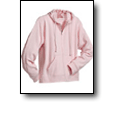


Fashionable Embroidery Embroidery Project
Tips for selecting the best blanks for your fashion embroidery.
Materials
Project Preview Video

Cut Away Stabilizer - 2.5 Oz wt.

Cut Away Stabilizer - 2 oz wt.
Tips for selecting the best blanks for your fashion embroidery.
Like any great artist, your embroidery must start with a blank canvas. In the embroidery industry, this is called a blank. Common blanks that are readily available to the commercial industry include T-shirts, golf shirts, caps, aprons, uniforms and much more. But often, we're looking for blanks that are more fashionable, more original. Machine embroidery is a wonderful tool for making a personal statement, updating a plain wardrobe or showcasing your talent. Let's take a closer look at blanks.
What to look for in a blank Avoid garments that have welt pockets, flat-felled seams, curvy princess seams, and impossible to detach linings and facings. The multiple layers of fabric that make up welt pockets and flat-felled seams can be difficult to hoop, as they do not allow the even distribution of tension in the hoop. |

The use of adhesive stabilizers enables you to hoop garments with welt pockets and flat-felled seams; however, professional results are achieved when stitching on a single layer of fabric. Avoid placing embroidery on the bulky areas and in fact, keep the embroidery a safe distance from the multiple layers so that the embroidery foot does not get caught in the bulk. Curvy princess seams are quite flattering on many figures but the curvier the curve, the harder it is to press the fabric flat so that the embroidery can be stitched. It's possible, but challenging. Turn the garment inside out and examine the lining and facing. Does the lining hang free at the hem? If so, it's the perfect candidate for embroidery since you can easily hoop the garment while keeping the lining out of the design area. If the lining is attached at the hem, see if removing a few stitches at the hem will enable you to separate it from the garment. Check the facing. Can you pull it away from the body of the garment, enabling you to hoop one layer? Can you maneuver around the permanent stitching of buttonholes?
|


Cardigans
Look for:
|

Sweatshirts, Blouses and Pullovers
Look for: Avoid:
|

Dresses
Look for: Avoid:
|

If you're interested in more information on embroidering on everyday, fashionable garments, purchase Eileen's latest book, Contemporary Machine Embroidered Fashions, complete with a FREE CD-ROM with 32 designs. |
