














































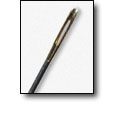


One Size Doesn't Fit All Embroidery Project
Choosing the correct needle size
Materials
Project Preview Video

Cut Away Stabilizer - 2.5 Oz wt.

Cut Away Stabilizer - 2 oz wt.
Choosing the correct needle size
Needle size denotes the diameter of the blade or shaft. The size that you would select for a job is dependent upon the thread size as well as the thickness or stiffness of the fabric.
In general, the larger the needle, the larger the eye. Thus thicker threads require a larger needle so that the thread can pass easily through the eye. To test the proper needle/thread combination, thread a loose needle with about 2 feet of the chosen thread. Alternately raise and lower each end of the thread, allowing the needle to slide back and forth. If the needle slides easily by its own weight, it is suitable for that thread size. As needles get larger in size, the diameter of the blade or shaft increases. The result is a stronger needle. For heavy, stiff fabrics, a larger size needle should be selected. However, since bigger needles are larger in diameter, they make larger holes in the fabric, thus they are not suitable for sewing fine details and small letters, or for dealing with lightweight or fragile fabrics. Therefore, the embroiderer must take into account fabric and design characteristics when selecting the proper needle for the job. |

