Border OptionsHugging border, circle, square, or rectangle — with a 3mm satin stitch.
Backing OptionsAvailable with iron-on, sew-on, or velcro backing.
Fast ShippingShipped quickly from the USA.
Free Online Tools
Powerful embroidery utilities that save time and prevent costly mistakes.
Stitch AssistantRECOMMENDED
Get the exact stabilizer, machine settings, needle, and thread color sequence for every embroidery design you purchase — based on that design's stitch density, dimensions, and color count.
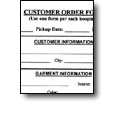
Along with having the proper resources, there is a whole art to making it work properly. For example, order forms. What is the perfect order form? Each business is different, so there is no one order form that is perfect for every business. The problem is that much of embroidery is custom, so it’s hard to cover every possible variation of every detail within a printed form. Some shops use elaborate multi-page affairs, while others use a blank sheet of paper. Ideally, you should start off with something simple that ensures you gather the needed details. Over time you can fine-tune the so-called form into a smooth working document.
A beginning order form could consist of a blank area at the top, followed by a series of questions to ask the customer. In the blank area, you attach artwork or draw a sketch of the design concept (or both). The questions at the bottom are to ensure that you get all of the required information. Example:
What is the customer’s contact info?
What date is the finished order required?
Do garments have to ordered? If so, list separately.
Does the same thing for on each garment? If not, create a separate order for each garment.
What is the design going to be sewn on?
Where should it be placed on the garment?
What are the colors?
What is the required size?
If keyboard lettering is required, which font? What letter height? What Color? Arc or straight? All capitals or upper/lower case? Etc.
If a stock design is used, what is the name and number?
No matter how simple the job is, it’s imperative that each work order can be reproduced by simply looking at the form. Make sure all the information is legible, and be sure to save notes about the setup, such as underlay, pull compensation, stitch lengths, density, etc. Most shops use the work order form to create a design information sheet that details all of the parameters necessary to sew and/or recreate the design.
Forms are a big part of the embroidery process. As your business grows, you will no doubt find that you need a variety of forms to cover a variety of issues. Using your business computer system, you will be able to create, modify and output forms for every occasion.
Award-winning author and international speaker Jimmy Lamb has over 15 years of embroidery experience as well as 10 years of professional digitizing experience (as a business owner). Currently, he is the Director of Training and Education for Hirsch International Corp., where he has been instrumental in developing their educational seminars.