
















































Digitizing Fundamentals II Embroidery Project
Run Segments vs Manual Segments
Materials
Project Preview Video

Cut Away Stabilizer - 2.5 Oz wt.

Cut Away Stabilizer - 2 oz wt.
Run Segments vs Manual Segments
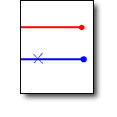
Run stitches and manual stitches appear to be the same thing to most novice digitizers, but they aren’t. With a manual stitch, each click of the mouse yields a specific needle penetration. With a run stitch, each click of the mouse yields a reference point. The computer will use these reference points calculate where (and how many) needle penetrations will be needed, based on the designated run stitch length.
With a run stitch segment, the computer decides the spacing between the needle penetrations. Suppose in the example above, your stitch length setting was 1mm and the distance between the endpoints was 4mm. All of the stitches would have the exact same stitch length. However, suppose the stitch length setting was 1.5mm. It would be impossible to create stitches with equal length as 4mm divided by 1.5mm does not yield a whole number. The end result is unknown, but it probably will be two stitches with a length of 1.5mm and one stitch with a length of 1mm. In many cases this is acceptable, but there may be situations, such as fine detail, where you want to ensure that you know where every needle penetration is going to occur. In that situation, the manual stitch is a better choice because each click of the mouse will yield the exact location of a needle penetration. |

