














































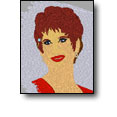


Digitizing Faces I Embroidery Project
Introduction & Overview
Materials
Project Preview Video

Cut Away Stabilizer - 2.5 Oz wt.

Cut Away Stabilizer - 2 oz wt.
Introduction & Overview
As a digitizer, you are faced with many design challenges everyday. Dealing with poor artwork, ensuring that outlines line-up, struggling to keep stitch counts low without diminishing quality, etc. And while many designs have elements that test your skills, nothing is more challenging than digitizing a face. There are basically two kinds of face embroidery, cartoon and photorealistic. Cartoon may sound like a description of a poor digitizing job, but it’s not. Cartoon faces can best be described as simple designs with little or no dimension and few details. Typically they are a small part of a larger design. For example, a passenger in a boat or perhaps a soccer player on the field. In these situations, the face is important, but it’s not necessarily a major feature of the design. Plus, the size is so small, that it’s best to keep it as simple as possible. Photorealistic faces on the other hand, are much more complex than cartoon faces. Usually, the face is the most prominent feature of the design, thus all of the attention is focused on creating an image that looks as realistic as possible. This type of face design is very challenging to create. There are several reasons for this. First of all, most of us see faces just like we learned to draw them as young children: a flat oval shape with a few lines representing the prominent features – eyes, nose and mouth. If you apply this perception to embroidery, the result is a flat filled area accented by a few runs and satins that create the basic facial details, but with very little dimension and texture. In reality, the face is quite complex, with many shapes, lines, color variations and shadows. The second problem is that faces are too easy to judge, such that any minor flaw or missing detail is very noticeable. The face stands out alone and naked for all to see. With wildlife you have fur and hair that obscures missing or blurry details, such that any minor indiscretions are muted or totally invisible; but not with a face. Thus, the digitizer finds that his/her work comes under constant scrutiny by all who gaze upon it. To ensure the best quality design, the digitizer must carefully plan his work before going to the computer. In fact, face digitizing requires much more advance planning than other designs. The first step in the digitizing process for a face is to study the artwork. You must “see” and examine every detail of the face. This means looking beyond the obvious. For example, the average person sees the lips, while the artist sees the curves, color, texture, shape and depth of the lips. If you can’t see the details, then you will have difficulty interpreting them in stitches. The best way to become familiar with facial details is to examine a real face, preferably the one that you are going to digitize. Stand about two feet back from the subject, at eye level. Do not use harsh overhead lighting as this will wash out the facial details. Normal daylight streaming in through windows, accented by low wattage household lighting is preferred, as this is how you really see most faces. Start at the top and work your way down. The first time you will see the face. The second time you will start to see what makes the face unique. The third time you should begin to see the details of the features. Here are some key points to focus on: shadows on each side of the nose, cheekbones, lines in the forehead, jawbones and the cut of the chin, and most importantly the eyes. In fact, the eyes are the most prominent and complex features of a face and require quite a bit of examination to understand their true characteristics. After examining a real life subject, turn your attention to the artwork and apply the same process to it, while thinking about what you observed with the real face. It helps to make a copy of the artwork and actually hand-sketch in some embroidery details as you analyze the facial details. |
