















































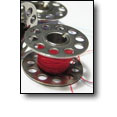


Bobbins: Types and Tips Embroidery Project
Bobbins are often out of sight during embroidery, but should not be out of mind.
Materials
Project Preview Video

Cut Away Stabilizer - 2.5 Oz wt.

Cut Away Stabilizer - 2 oz wt.
Bobbins are often out of sight during embroidery, but should not be out of mind.The sewing process requires two different threads to make a stitch – the top thread and the bobbin thread. In fact a stitch is formed when the two are joined together. Since the bobbin thread is not seen, little attention is paid too it. But in actuality it’s a very important part of the embroidery process.
Many embroiderers don’t realize that there are many types of bobbins available today. Most machines are designed such that you can wind your own bobbins, but this is not recommended due to the low cost of purchasing pre-wound ones. Typically, pre-wound bobbins are available in the following fiber types: continuous-filament polyester, spun polyester, cotton and nylon |

Continuous-Filament Polyester This is the most popular type of bobbin among U.S. embroiderers. It is strong, thin, consistent, and does not leave behind any lint. On the other hand, it has the potential to leave a waxy deposit on bobbin cases. In addition, its thinness sometimes makes it hard to adjust the tension properly. Spun Polyester A growing number of embroiderers are turning to this bobbin type as it has a texture similar to cotton, but without the lint problems associated with cotton. Cotton This bobbin thread is not as strong as the synthetics, but embroiderers usually choose it because of its texture, which allows for a wide range of bobbin tension adjustments. The main drawback for cotton thread is the amount of lint that it gives off, which causes undesirable buildups in the bobbin case. Nylon Nylon bobbin thread is perhaps the strongest of all bobbin thread types. However, its small diameter and slick texture make it difficult to maintain consistent tension, which can lead to sewing quality problems. There are two bobbin sizes, designated as L or M. Your machine supplier will designate which one fits your machine. L is the most common for commercial embroidery machines. It holds between 130 and 154 yards of bobbin thread. The M bobbin can hold up to 235 yards of bobbin thread.
|

