
















































Overcoming Cap Anxiety: Part III Embroidery Project
Understanding Frame Options
Materials
Project Preview Video

Cut Away Stabilizer - 2.5 Oz wt.

Cut Away Stabilizer - 2 oz wt.
Understanding Frame Options
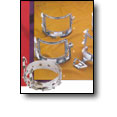
There are thousands of sewing templates used in the world today to create baseball style caps. Thus, there are many variations in size and shape. So why would you expect one cap frame to work for everything? Most embroiderers only have a single type of frame: the frame that came with their machine. However, there are other styles available. Rather than limit what you offer, why not expand your capabilities?
The window frames work best on caps that have straight vertical front panels. They grip the front panel from four sides, but have a very limited sewing area because of the four-way framing. However, the window frame is one of the best tools for doing the back of a cap. It also works well for bucket hats. The 270 works best on caps that have a front panel with vertical curvature, such as the low profile styles. They only grip the cap along the bottom of the crown and allow a large sewing field that theoretically covers 270 degrees of range, thus the name. This allows for sewing on the front and both sides without re-hooping. In addition, there is no vertical barrier, which allows it to accommodate a variety of different crown shapes. However, these frames are not suitable for sewing on the back of the cap. In addition, the physical limits of a cap still restrict how much embroidery can be placed it. |

