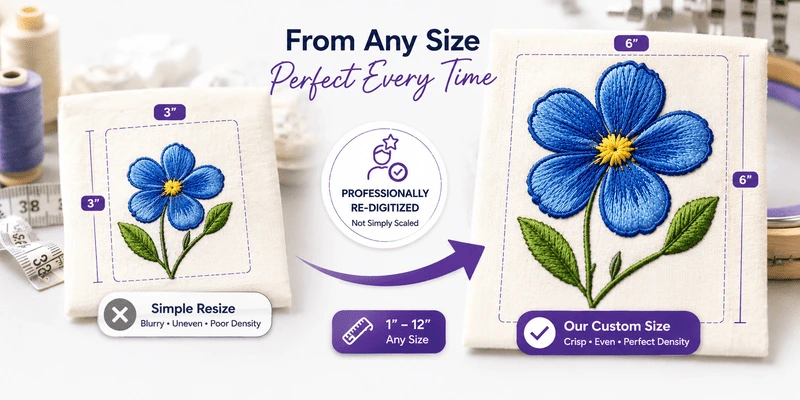
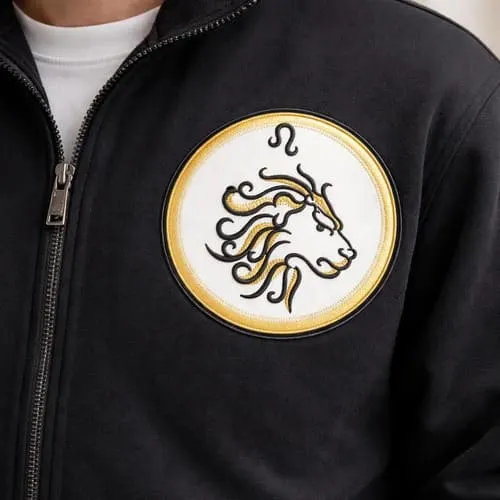
Border OptionsHugging border, circle, square, or rectangle — with a 3mm satin stitch.
Backing OptionsAvailable with iron-on, sew-on, or velcro backing.
Fast ShippingShipped quickly from the USA.
Free Online Tools
Powerful embroidery utilities that save time and prevent costly mistakes.
Stitch AssistantRECOMMENDED
Get the exact stabilizer, machine settings, needle, and thread color sequence for every embroidery design you purchase — based on that design's stitch density, dimensions, and color count.
SVG and FCM files are available with the design downloads to precut the star appliques. A PDF file is available in the design downloads to precut them by hand, or the stars may be appliqued using the stitch and trim method. To access the cutting files be sure to click on “Show All File Types“ in the download window. Another PDF file is attached to this article to cut the circle ends of this bolster pillow, print it out at 100% from these instructions or use a compass to draw a 7” circle to cut the end pieces.
Step 1:
Separate 3 red and 3 white 2.5” strips from the jelly roll or cut across from across the width of cotton fabric. Cut the strips in half so that you have 6 strips of each color.
(Click Image to Enlarge)
Step 2:
Cut the Battilizer® to 21” x 17” rectangle. As Battilizer® contains stabilizer it will go through your sewing machine nicely. If using another low loft batting that does not contain stabilizer, cut a piece of poly mesh stabilizer to put behind the batting. Measure 5” across the 21” width of the batting and draw a line with a Frixion® pen, draw a line vertically down the center of the batting.
(Click Image to Enlarge)
Step 3:
Center a red strip over the vertical line having the top edge of the strip about ½” over the top horizontal line on the Battilizer®; lay a white strip over the red strip and stitch down one side with a ¼” seam allowance. Note: Using a stitch length of 3 mm makes for smoother stitching on batting and fabric.
(Click Image to Enlarge)
Step 4:
Press the white strip to the side; place another white strip over the red strip and stitch down to the other side of the red strip; press to the side.
(Click Image to Enlarge)
Step 5:
Continue adding strips and pressing them open alternating red and white strips until the fabric is covered.
(Click Image to Enlarge)
Step 6:
Trim off the excess of the strips at the bottom and sides of the pillow cover; redraw the 5” placement line for the navy at the top of the pillow cover.
(Click Image to Enlarge)
Step 7:
Cut a strip of navy fabric 8” wide the width of the fabric fold in half lengthwise and press to get a center line for placement of the stars; do not press out the original crease in the fabric as you will use that as a center mark as well.
(Click Image to Enlarge)
Step 8:
You will now make 4 marks on the navy fabric to mark the centers where the stars will be appliqued. Make a mark 2.5” up from the center crosswise fold and on the center lengthwise crease; make a mark 2.5” down from the center fold; make a mark 5” up from your first mark and 5” down from the 2md mark.
(Click Image to Enlarge)
Step 9:
Hoop the navy fabric with poly mesh stabilizer with the lengthwise crease of the fabric horizontal in a 4” x 4” hoop and aligned with the marks on the sides of the hoop, center the white mark as close as possible in the hoop.
(Click Image to Enlarge)
Step 10:
Prepare the white fabric for cutting the star appliques; cut 2 4” x 8” of fabric; press 4 times spraying with Magic Sizing each time; apply Heat N Bond Lite® to the back of each piece. Do this regardless of if you are cutting with an electronic cutter or using the Stitch and Trim Method.
(Click Image to Enlarge)
Step 11:
The smallest size of the star appliques is used in this project. Stars are not symmetrical so if you cut them with an electronic cutter or by hand make the top of the star with a Frixion pen, it will disappear when you iron the applique into place, but you will know that it is right side up and will fit in the placement line.
(Click Image to Enlarge)
Step 12:
Load the design into the machine and run color stop (CS 1) to stitch the placement line.
(Click Image to Enlarge)
Step 13:
If using precut appliques, iron the applique into position. If using the stitch and trim method cut a 4” square of the prepared white fabric; spritz with adhesive; and lay over the placement line; do not iron on until after the next step.
(Click Image to Enlarge)
Step 14:
Run CS 2 as a tack down line; if using the stitch and trim method trim the excess fabric right up to the tack down line. This line will just outline the star again if you are using precut appliques and let you know that you applique is in the correct position.
(Click Image to Enlarge)
Step 15:
Run CS 3 to border the star. Repeat steps 12 through 15 three times to stich appliques over the white dots you made on the navy strip.
(Click Image to Enlarge)
Step 16:
Trim the poly mesh stabilizer around the stars.
(Click Image to Enlarge)
Step 17:
Fold the band with the stars in half; measure up 11” and trim so that you have a 22” band with appliqued stars.
(Click Image to Enlarge)
Step 18:
(Click Image to Enlarge)
Pin the band to the batting having the raw edge ½” to the left of the line you drew on the pillow cover; center the fold in the band with the center of the pillow cover; stitch in place with a ½” seam allowance.
Step 19:
(Click Image to Enlarge)
Press the band up to cover the batting. You should have a ½ overhang on each end of the band; trim this even with the pillow cover.
Step 20:
Fold the pillow cover right sides together so that the band and two white stripes meet; baste together with a long straight stitch (6mm).
(Click Image to Enlarge)
Step 21:
Press the seam open.
(Click Image to Enlarge)
Step 22:
(Click Image to Enlarge)
We are going to do a simplified zipper installation. Place the zipper face down on the seam allowance with both the top and bottom zipper stops extending beyond the ends of the pillow cover. Center the teeth of the zipper on the seam line.
Step 23:
Attach a zipper foot to the machine; return your stitch length to 3mm; stitch the zipper to the seam allowance stitching as close to the zipper teeth as possible; stitch the other side of the zipper to the remaining seam allowance in the same way.
(Click Image to Enlarge)
Step 24:
Remove the basting stitches that were stitched through the navy band; pull the zipper tap down a few inches into the band; alight the top edges of the band and stitch though the zipper and band to form a new zipper stop with a ¼” seam allowance. Stitch trough the bottom of the zipper and the white stripes at the bottom of the pillow cover in the same way.
(Click Image to Enlarge)
Step 25:
Trim the zipper off at both ends of the pillow cover.
(Click Image to Enlarge)
Step 26:
To reduce bulk in the end panels we are going to line them with tricot interfacing instead of batting. Cut two 8” squares of both navy fabric and tricot interfacing; apply the interfacing to the fabric following the manufacturer’s instructions. Print the PDF file attached to this project or use a 7” in diameter sauce pan to draw a circle on a piece of paper.
(Click Image to Enlarge)
Step 27:
Pin the paper pattern to the fabric and cut two circular ends.
(Click Image to Enlarge)
Step 28:
With the pillow cover still inside out pin the circle end to the pillow cover right sides together. When pinning the circle to the end of the pillow that is at the top of the zipper be sure the zipper is opened to the bottom of the blue band so that you will be able to turn your pillow after both ends are stitched in place. Stitch the ends on with a ½” seam allowance; stitch slowly to be able to turn around the curves and reposition the body of the pillow often to keep the body from forming tucks as you stitch. Stitch both ends into place.
(Click Image to Enlarge)
Step 29:
Clip the seam allowances around the circles for a smoother shape when the pillow cover is turned.
(Click Image to Enlarge)
Step 30:
Turn the pillow cover right side out though the open zipper in the band. Remove the rest of the zipper basting stitches; use a tailor’s ham or folded towels to stuff inside the pillow cover to press the circular seams.
(Click Image to Enlarge)
Step 31:
Find the center of the circular end at the top of the pillow cover mark with chalk.
(Click Image to Enlarge)
Step 32:
Hand stitch the tassel to the center mark with matching thread.
(Click Image to Enlarge)
Step 33:
(Click Image to Enlarge)
Insert the pillow form. Congratulations your Firecracker Bolster Pillow is complete!
Award winning Digitizer, Embroidery Educator, Author and a Consultant to the Industry, Pat Williams has 30 years of experience in the embroidery industry. Pat has won multiple awards for her digitizing expertise including the 2007 Impressions Awards Grand Championship, Best of Show as well as the 1st and 2nd Place Awards. Pat’s love of digitizing has afforded her the opportunity to write numerous articles for Impressions magazine in the United States and Images Magazine in Europe. In 2001 Pat was named “Embroidery Educator of the Year.” For many years Pat taught digitizing seminars at the ISS Shows in Long Beach, CA and for Compucon software. She now resides in Tucson, AZ.