



PROJECT INSTRUCTIONS


PROJECT INSTRUCTIONS

Threads & Bobbins Embroidery Project
By
Bonnie Landsberger
on
September 06, 2022
PROJECT DETAILS
Description
Threads to an embroiderer are like paints to an artist – you can never have enough colors on your palette.
Project Preview Video

Stack N Store Bobbin Towers
$62.85
Circle Price: $62.85

Isacord Top 10 Thread Kit
$69.99
Circle Price: $69.99

Threads & Bobbins |
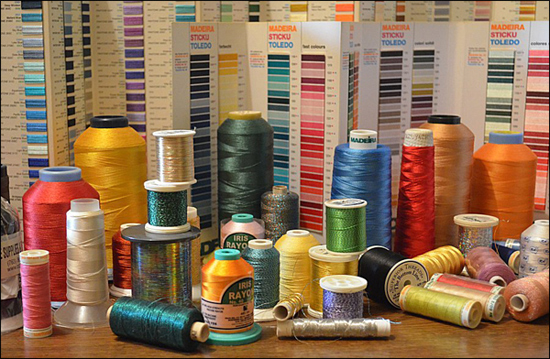 | Threads & Bobbins Threads to an embroiderer are like paints to an artist – you can never have enough colors on your palette. But having an abundance of thread can be a bad idea unless it can be stored properly or used in good time. According to manufacturers, a high quality thread has an indefinite shelf life when stored in the right environment. So, if you’re unable to keep it appropriately protected, it’s best to stock only the colors you’ll use the most often and purchase other colors when called for in projects. With so many thread choices, deciding which to buy and keep handy can be difficult. Learning a bit about thread and caring for it can save the life of what you have in stock, as well as your money. Click on the small thumbnail images to enlarge. Thread Colors Do not buy thread just because the color is pretty. I have made that mistake and those colors still sit on the shelf, unused after decades. But you do need to begin somewhere and choosing the colors of thread to keep in your stock is a difficult decision. If you set out to have every color of the rainbow on hand, the cost could exceed the price of your machine, and it’s likely you would never use a good majority of it. You will use white and black more than other colors, so it’s safe to buy those in the larger cones, but it’s best to begin your thread stock with the smaller cones or spools of a variety of basic colors. There are kits and samplers available from most major thread manufacturers that are always a wise choice, even for the seasoned embroiderer who finds they only need a small amount of several colors in the kit for a particular job. If you then find that you are using one color more than others, buy a larger size of that color in the future. There will be a spool or two in the kit you may never use, but if it’s stored well, it will be there for you in the future to use in that one particular design that needs a bit of that color. Thread Brands Do not buy thread just because it’s “cheap”. There’s a reason why it doesn’t cost as much as the higher quality threads, which you will discover with every thread break it produces or when seeing the “bleeding” of thread color into the fabric after the item is laundered. Stick with a quality thread from a reputable manufacturer that is produced specifically for embroidery. At first, the cost can be overwhelming, but keep in mind that thread is the major ingredient in embroidery and it must be strong enough to handle running through the machine at high speeds, so it should be considered a justified investment. If you purchase a lower quality brand because it’s more affordable, after the trouble you experience when using it, those bargain cones will likely end up sitting on the shelf right next to those pretty colors that never get used. Thread Weights First, understand that the thicker the thread, the lower the weight number. Most stock designs are digitized for 40 WT threads, so it’s the best choice for a new embroiderer to make in the beginning. A 60 WT thread is much thinner and is often used to stitch very small lettering to help retain clarity, as well as a tidy appearance. A 30 WT thread is thicker and offers more coverage, such as when stitching on a wool blanket or other thick fabric, or when densities in a design are lightened during the digitizing to achieve a lower stitch count, or when a machine file is increased in size and density becomes too thin for a 40 WT. Thread Types There are many different types of thread to choose from and new types continue to appear on the market. Common types that are most often used by both commercial and domestic embroiderers are as follow: RAYON: Preferred by some embroiderers for its high sheen and tensile strength for smooth sewing. Although quality brands have improved greatly in recent years, some types of rayon will bleed into fabrics when laundered. The first time you use a particular brand of rayon thread, it’s wise to test by stitching on a fabric scrap and toss into the wash. POLYESTER: Desired by many commercial embroiderers who stitch in high volume because of its tensile strength and colorfastness, thereby assuring no customer returns due to bleeding when laundered. Although it has a lower sheen than rayon, the quality of today’s polyester is much improved with a definite shine. COTTON: A soft, natural thread with a matte finish, it’s often the quilter’s choice for machine stipple designs. At one time, cotton was difficult to run on the embroidery machine due to its tendency to shed lint and lower tensile strength, however, due to a process of “mercerizing” that burns off the fuzzy fibers, today’s cotton thread is strong, and the shedding, as well as shrinking, has been nearly eliminated. METALLIC: Manufactured with a center core wrapped with metal foil or thin slivers of metal foil, and color is added with a polyester film. Desired for sparkly accents to embroidery, it is known to be difficult to stitch, but using the correct needle with a larger eye, as well as slowing the machine while sewing will improve results. MYLAR: Made from plies of film layered together, then cut into narrow strips to form a flat filament thread. Mylar is available in a wide range of colors as well as holographic hues that pick up light and color from surrounding objects for luminous, bright results. SILK: Easily absorbs dyes, producing a brilliant color and high sheen, and its strength lends to smooth sewing. At the higher end of cost, it is most often used for embroidery on luxurious fabrics. SPECIAL-EFFECT: There are a variety of threads available that help create one-of-a-kind embroidery, such as a fuzzy acrylic and wool for a hand embroidered look or a solar type that changes colors when exposed to sunlight. There are fluorescent neons, tweeds, and those that glow in the dark, along with numerous others. Usually found at a higher cost, most embroiderers purchase special effect threads only when necessary for a particular project, but it doesn’t hurt to keep one or two small spools for those adventurous days of experimentation. Very often samples are offered at embroidery events and trade shows, and some manufacturers offer small samples at a low price. |
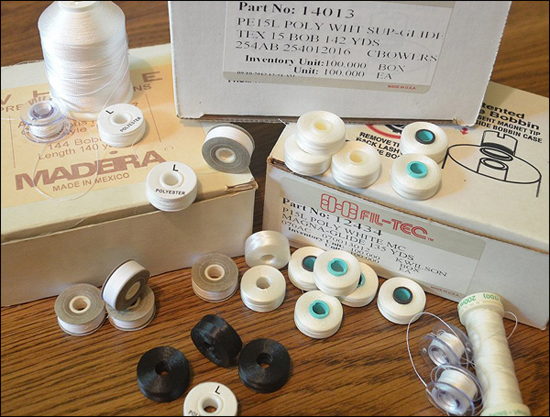 | Bobbin Thread The bobbin thread is loaded below the needle plate and during sewing it connects to the top thread to hold the stitches securely in place. For some projects that will show both sides of the embroidery, as with a napkin, embroiderers will wind the bobbin with the same thread as used for top thread, but in general, a less expensive thread manufactured specifically for the bobbin, works very well. Most commonly it is found as a thin 60 WT polyester; a strong, thread that lies closer to the fabric, eliminating unnecessary bulk. Some embroiderers who prefer to wind their own bobbins purchase bobbin thread by the spool or cone, and others who produce a high volume of embroidery, or those who have a personal preference to remain prepared, purchase pre-wound bobbins by the case. The L-style pre-wound bobbin works for most all machines; some have cardboard sides, plastic sides or no sides at all. Commercial machines work very well with bobbins that have a magnetic core because the magnetic force stops excessive spinning, which is often the cause of thread breaks. Testing different styles of pre-wound bobbins will reveal which works best in your particular commercial machine. Some home machines are reported by users to sew best with a 90 WT polyester bobbin thread available in spools, cones and pre-wound Class 15/A 90# Weight. Machine models include Brother: PE-700, PE-750D, PE-150V, PE-170D, PE-180D, PE-700II, PE-780D, PE770, PE500, HE1, DreamMaker™ XE VE2200, and Simplicity SB7050E; also various models of Baby Lock, Bernina, Singer, and most all models of Janome machines. Many machine manufacturers offer their own brand of 90 WT bobbin thread to be used specifically on their machines.Check your manual for the manufacturer’s bobbin recommendation. Thread & Bobbin Storage If you want your threads to last, give them a good home. Keep them safe from sunlight and dust, and be aware that thread does best in a constant average humidity. Direct sunlight, will not only fade color, it can dry out and rot the fibers. Dust that collects on the spool or cone will make its way to the machine, causing sewing problems like thread breaks. Humidity either too low or too high will damage thread; if the area is dry, threads will become brittle and if it is high, threads can mold. Evaluate your environment with the use of a humidity gage and use a humidifier or dehumidifier to adjust the percentage accordingly to what is necessary to maintain an average of about 40-60%. In the Midwest where it is most often humid in summer and requires a dehumidifier to avoid mold, it becomes extremely dry indoors during the winter months. My solution has been to run an inexpensive vaporizer in the sewing room when the humidity gage drops below 35%. Manufacturers advise to also maintain temperature between 50 ˚F and 77 ˚F (15 ˚C and 25 ˚C). Small spools of thread and bobbins can be stored in plastic containers where they are safe from most all environmental issues, but this storage solution can become quite costly, especially if you acquire an abundance of large cones. Thread racks or pegs with peg board can be used, combined with the protection of a curtain or in a cabinet or closet to keep out dust and sunlight. I keep my threads on a 4-shelf unit, faced away from the window and covered with a curtain to keep out any room or sunlight, as well as dust. |
| Troubleshooting If you have had thread stored awhile and you’re not sure of its quality, you can test the brittleness by pulling about 12” of thread from the cone and holding this between your two hands, and then give it a good tug. If there is some restraint and it breaks with a fairly loud snap, the thread is in good shape. If there is no snap and the thread breaks apart easily with frayed ends, the thread has become too dry and useless for machine embroidery. One knot made by the manufacturer during production to complete winding a cone will cause the thread to break, and this is to be expected to happen on a rare occasion, but more than one knot in one cone or more than one cone with one knot received in one order of multiple cones (very rare with a reputable manufacturer) is unacceptable and should be returned immediately. As well, if a new spool or cone of thread does not pass the quality test, don’t hesitate to return the thread for a replacement. Every now and then damage can occur unwittingly during processing, most especially in dark colors like navy blue or black that require a longer processing time than lighter colors. Note, for multi-needle machines, it’s best to thread the darker colors through the needle that has the shortest path between cone and needle to avoid thread breaks from strain. Place spools on the machine so that the thread will come off of the spool without crossing over itself so that it unwinds smoothly. To determine the correct placement, hold spool in one hand and pull thread end in the direction that the machine will be pulling it from the spool. If the thread crosses over the unwound threads it will not unwind smoothly and it could cause thread breaks. If a cone of thread is dropped it may cause what is referred to as a “bruise”. The damage changes the manner of the way the thread unwinds and this can affect tension, leading to thread breaks, as well as strands that simply fall to the base of the cone into a puddle. You can try holding the cone narrow end up and allow bruised strands to fall away, but this can result in a tremendous waste. Instead, try a thread “sleeve” or “sock” that slips around the outside of the cone to hold the threads in place, while allowing the thread to unwind without puddling. Thread socks can be found at various thread suppliers. When you find thread has been damaged during storage, it is more cost efficient to just toss it in the trash. On the other hand, you can salvage the cone by using it for zigzagging raw edges to keep fabric from fraying or for a situation like basting when you want the thread to break easily, but keep all damaged threads separated from your good threads to be sure they aren’t used accidentally in the future for any other purpose. I have one such cone that I have run a felt tip marker across the top to make sure it gets my attention and never gets used for permanent stitching. |
Projects You May Like
Meet the Author:
Bonnie Landsberger

Bonnie Landsberger has been a crafter and hand embroiderer since childhood and a machine embroiderer and digitizer since 1986. She was the in-house head digitizer for a 50-head embroidery shop for 11 years and later offered custom digitizing services and stock design sales through her web site for Moonlight Design since 1993. She currently also holds a position as a customer service representative at EmbroideryDesigns.com.
Bonnie has won several awards for digitizing, including a gold medal in the 2002 Digitizing Olympics and grand prize in all categories & first place for Winter Holidays category in the Stitches Magazine Great Greeting Card Contest 2003.
Her embroidery and digitizing technical articles can be found in various trade magazines and she is currently a contributing writer and Editorial Advisory Board Member for Stitches Magazine. You can also find more of her articles online at EmbroideryDesigns.com and will continue to contribute articles to our Learning Center.
Feedback
Characters Remaining
Please Login to Submit a Feedback
Invalid Characters, Please enter a valid Comment
Please enter a valid Comment
Reviewed On
Link is Broken, Please check the URL