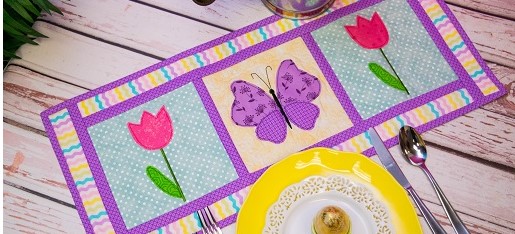
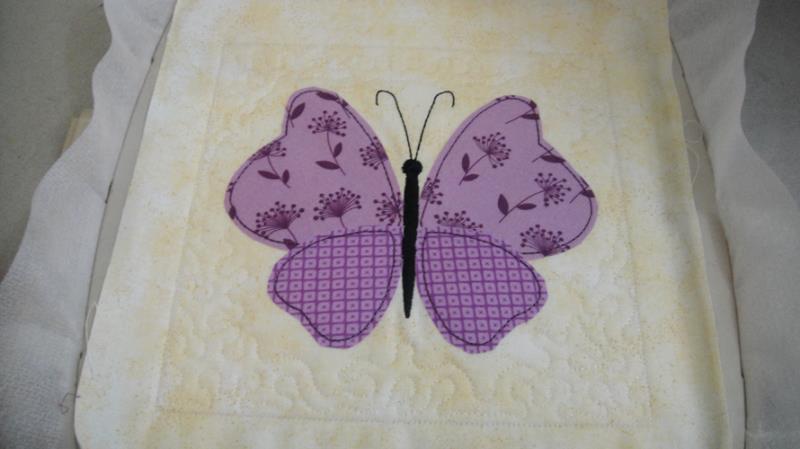
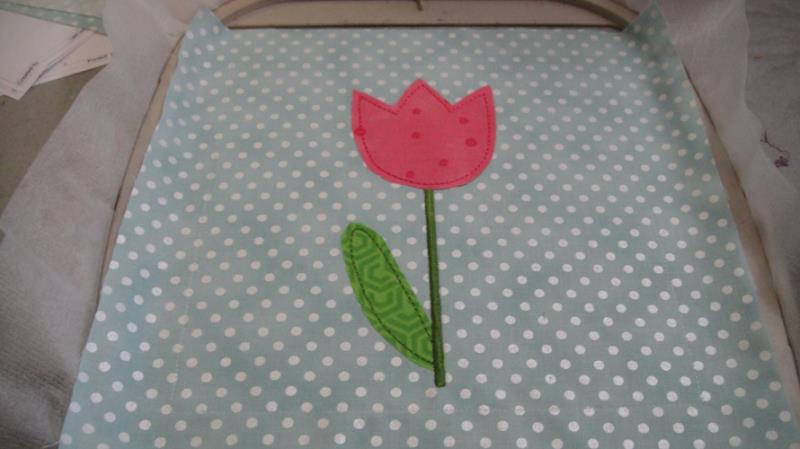
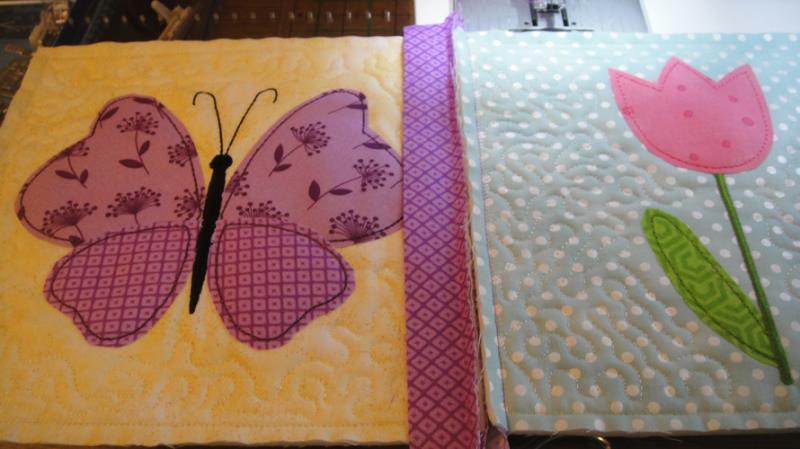
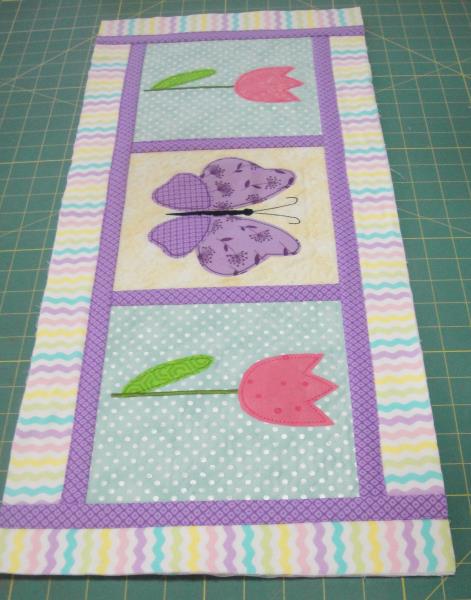
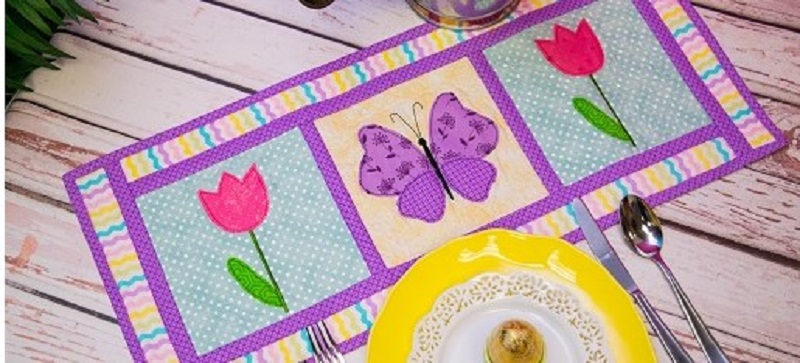
The three center squares are appliqued and quilted in the hoop. They are joined to each other and to the borders at your sewing machine using the technique described in this project. You may alternately use the method for joining the squares and applying the sashing with invisible thread as described in the Prim Pear Table Runner project https://www.embroiderydesigns.com/emb_learning/project/1210/prim-pear-table-runner The choice is yours.
Step 1:
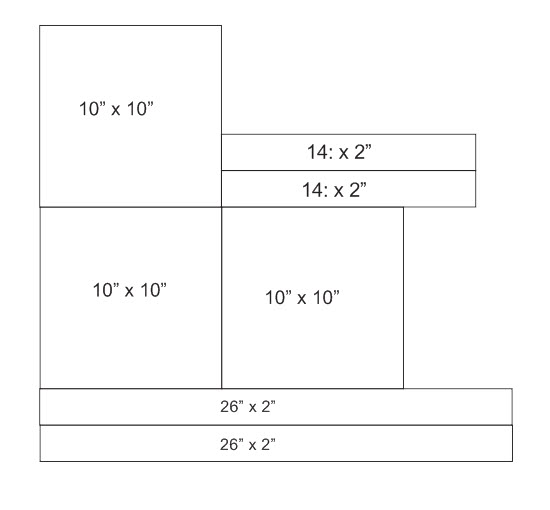
Cut your ¾ yard of Battilizer® as shown in this diagram.
(Click Image to Enlarge)
Step 2:
(Click Image to Enlarge)
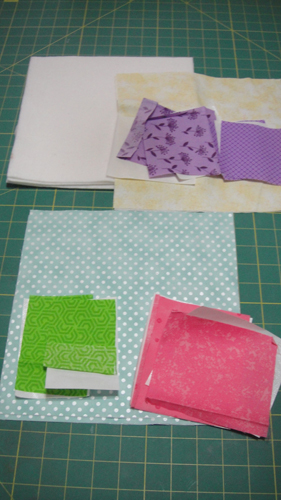
For the center blocks cut: a. 4 10” squares of the Aqua Dot fabric b. 2 10” squares of the Yellow fabric c. 2 5” x 4 ½” rectangles of the Coral fabric and Heat N Bond Lite® d. 2 3” x 4 ½” rectangles of the Green fabric and Heat N Bond Lite®
Step 3:
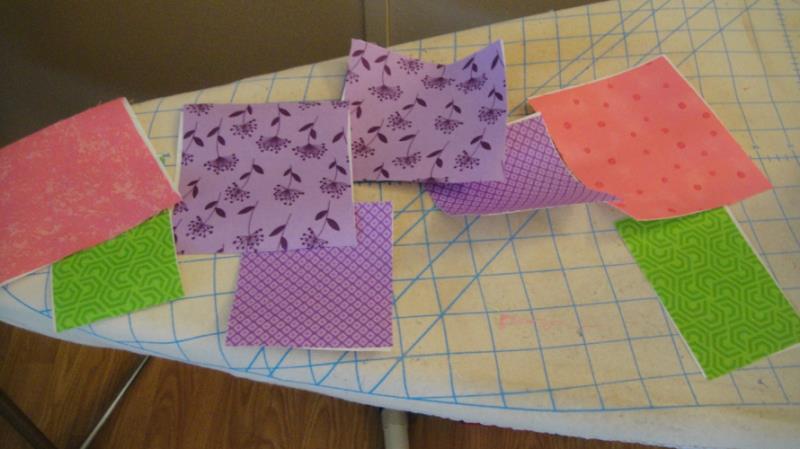
Spray your applique fabric three or four times with Magic Sizing and press. Following the manufacturer’s instructions apply to Heat N Bond Lite® to the back of each applique.
(Click Image to Enlarge)
Step 4:
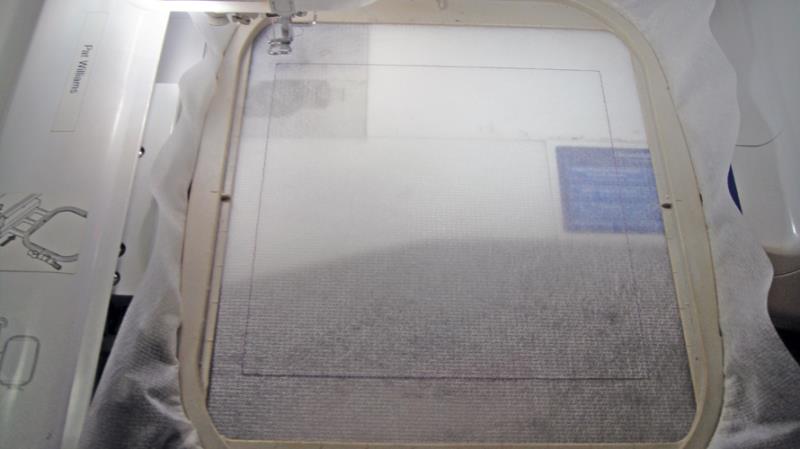
Hoop one layer of no-show stabilizer tautly in your hoop. Run color stop (CS) 1 in any color as a placement line for the fabric.
(Click Image to Enlarge)
Step 5:
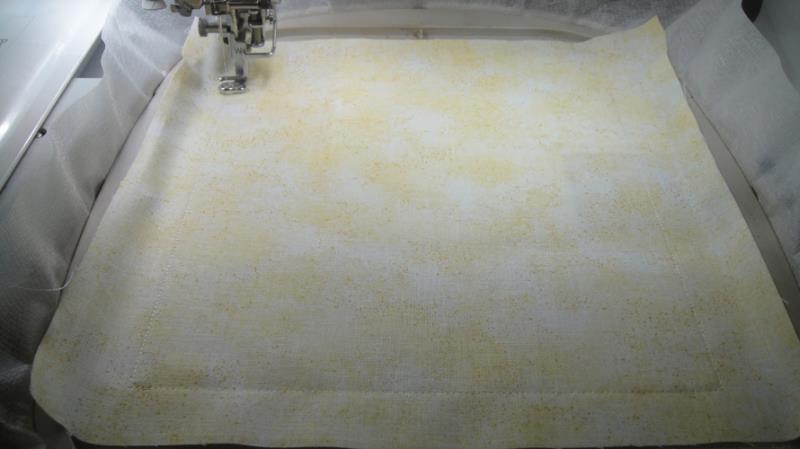
Spray adhesive on the wrong side of the 10” square background fabric and position over the placement lines so that the fabric exceeds the placement line by ½” on all sides. Run CS 2 in water soluble thread to tack down the fabric.
(Click Image to Enlarge)
Step 6:
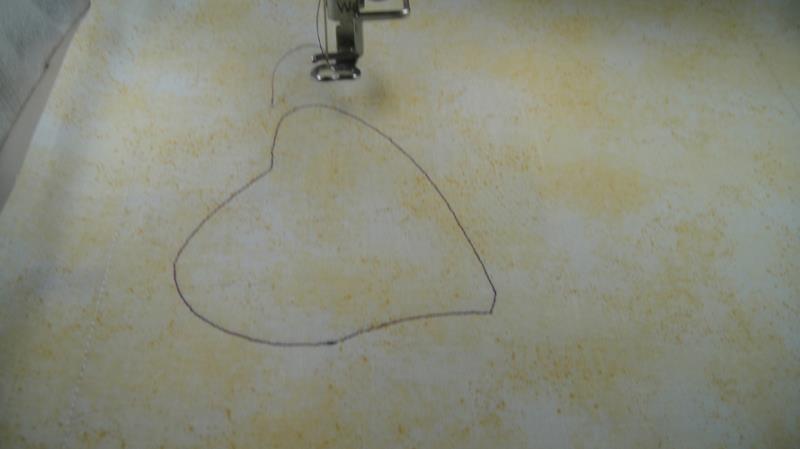
Run CS 3 in a color to match your fabric applique pieces, this is a placement line for the upper wing.
(Click Image to Enlarge)
Step 7:
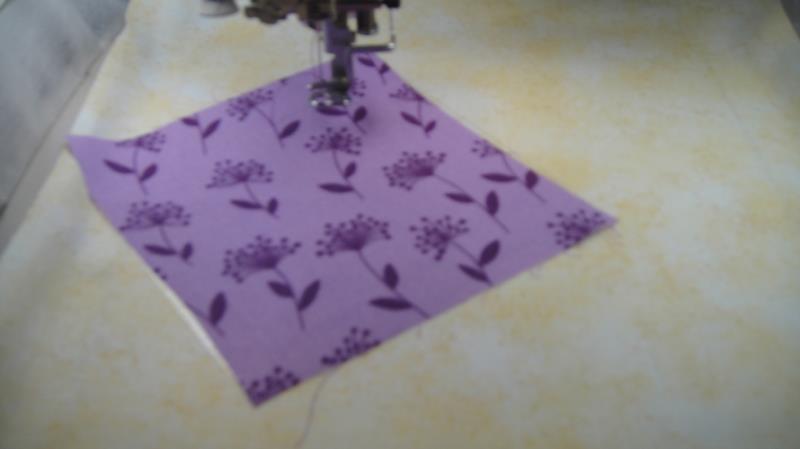
Peel the paper from your upper wing fabric, spray adhesive on the back and position over the placement line so that the fabric exceeds the placement line by ½” in all directions. Run CS 4 to tack down the wing.
(Click Image to Enlarge)
Step 8:
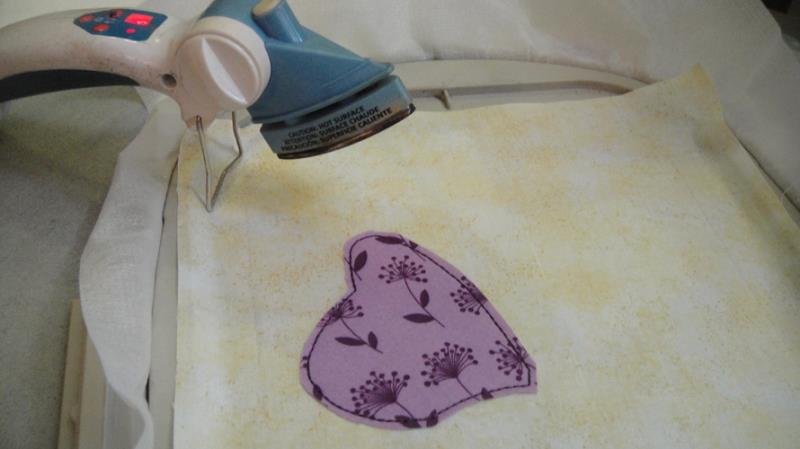
Remove the hoop from the machine, do not unhoop, place on a flat surface and trim the applique approximately 1/8th from the tack down lines. Press the applique with an applique iron.
(Click Image to Enlarge)
Step 9:
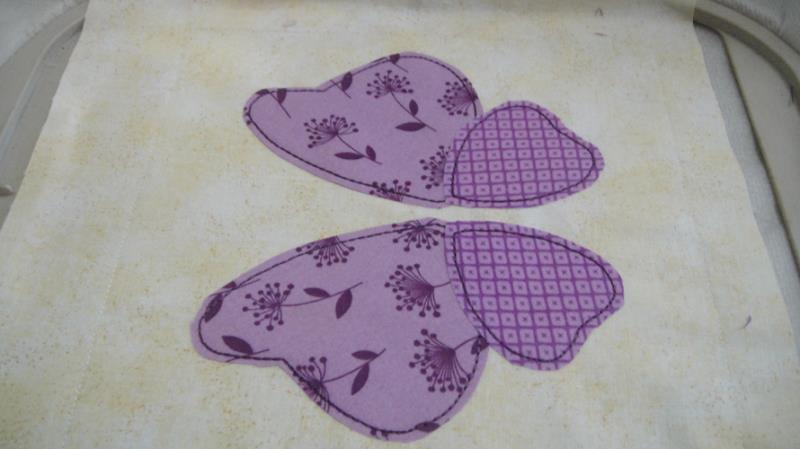
Repeat Steps 6 through 8 to apply the rest of the appliqued wings.
(Click Image to Enlarge)
Step 10:
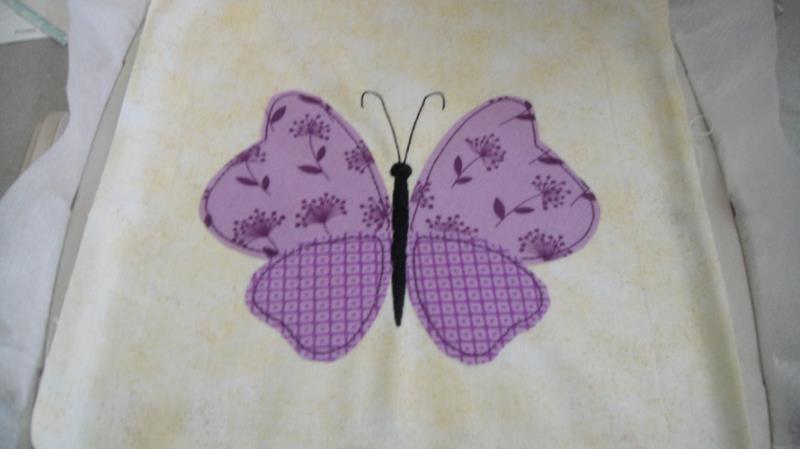
Run CS 11 in Emerald Black (1000) to stitch the body and antennae.
(Click Image to Enlarge)
Step 11:
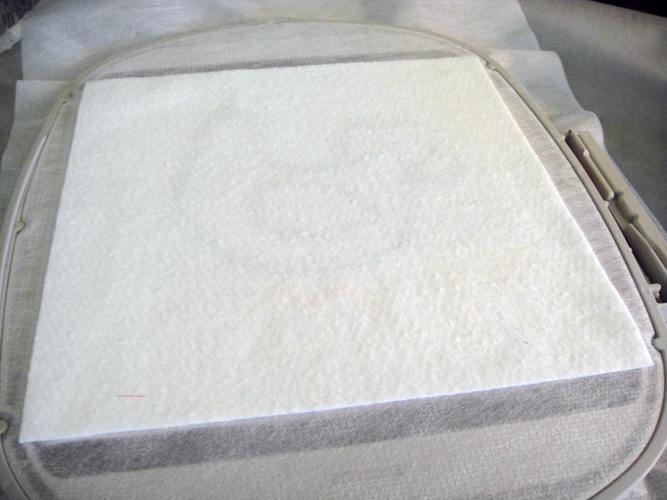
Remove the hoop from the machine, do not unhoop, place the hoop on a flat surface, spray adhesive on a 10” Battilizer® square and position over the back of the embroidery so that the Battilizer® exceeds the placement line by ½” on all edges. Spray the back of the corresponding back fabric and place exactly over the Battilizer®.
(Click Image to Enlarge)
Step 12:
Run CS 12 in Water Soluble Thread to tack the Battilizer® and back fabric to the quilt block. Run CS 13 in Super White (1001) or desired color for the quilting.
(Click Image to Enlarge)
Step 13:
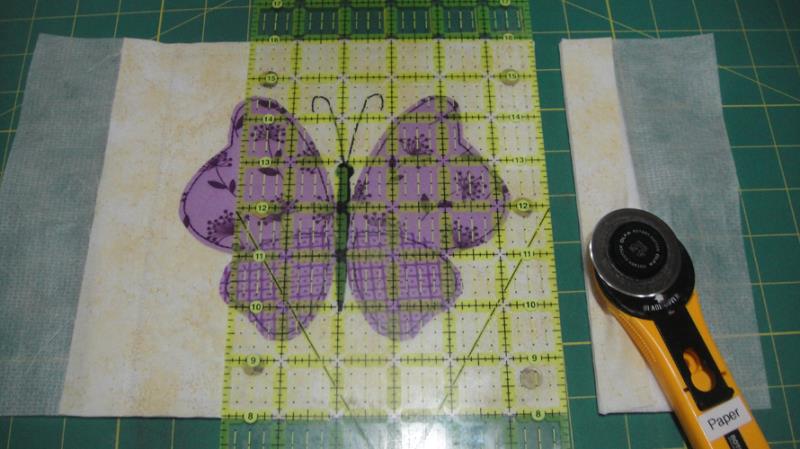
Lay a see through ruler’s ¼” mark on the Water Soluble Tack down stitch line and trim all edges to ¼”.
(Click Image to Enlarge)
Step 14:
The construction of the Tulip block is the same as the block above, but you only have two appliques to complete. One for the leaf and one for the Tulip blossom. Make two Tulip blocks.
(Click Image to Enlarge)
Step 15:
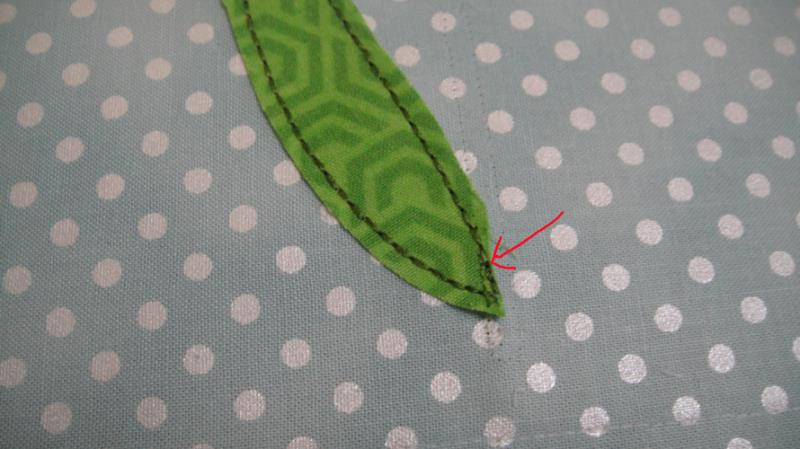
The Tulip leaf is applied first to this block. Trim the bottom right hand edge of the leaf applique right up next to the tack down lines so it will not poke out the right hand side of the stem.
(Click Image to Enlarge)
Step 16:
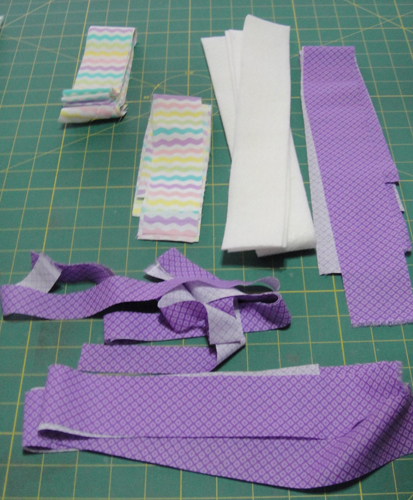
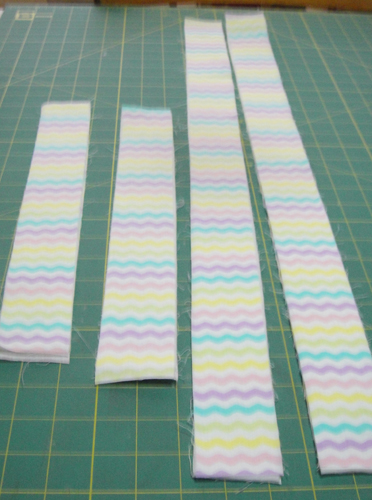
To complete the table runner cut: a. 4 Border pieces from the rick-rack print 2” x 26” b. 4 Border pieces from the rick-rack print 2” x 14” c. 3 Sashing strips from the Lavender print 2” by the width of the fabric d. 3 Sashing strips from the Lavender print 1” by the width of the fabric e. 3 Binding strips from the Lavender print 2 ¼” by the width of the fabric f. If you haven’t done so already cut 2 Battilizer® strips 2” x 26” and 2 Battilizer strips 2” x 14”
Step 17:
(Click Image to Enlarge)
Make quilt sandwiches from the border fabrics and Battilizer® by spraying one side of a Battilizer® with spray adhesive and placing a corresponding strip of border fabric over it right side up. Spray the other side of the Battilizer® with adhesive and placing a corresponding strip of border fabric face up on the Battilizer®.
Step 18:
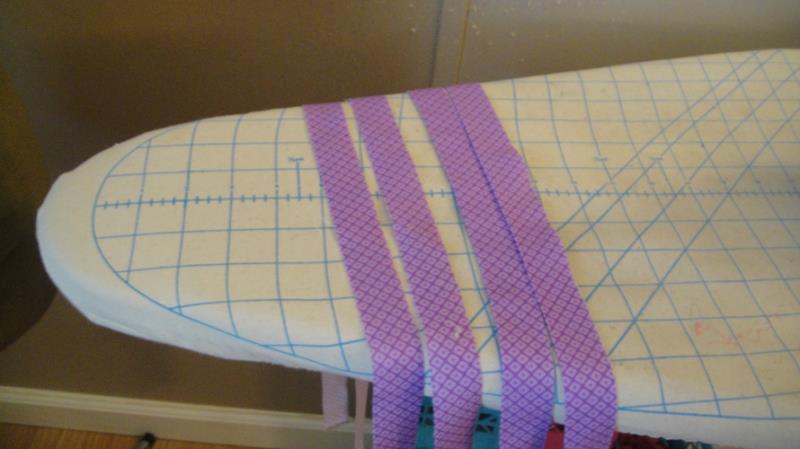
Spray the sashing strips with Magic Sizing and press. Press the 2” strips in half lengthwise.
(Click Image to Enlarge)
Step 19:
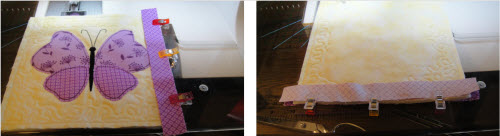
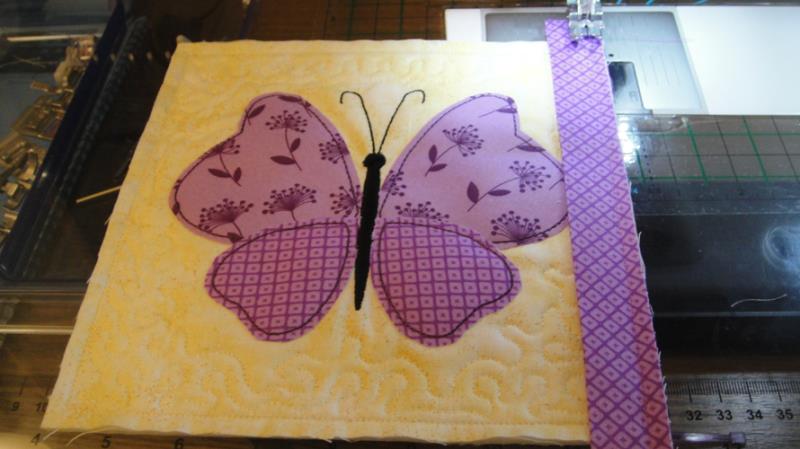
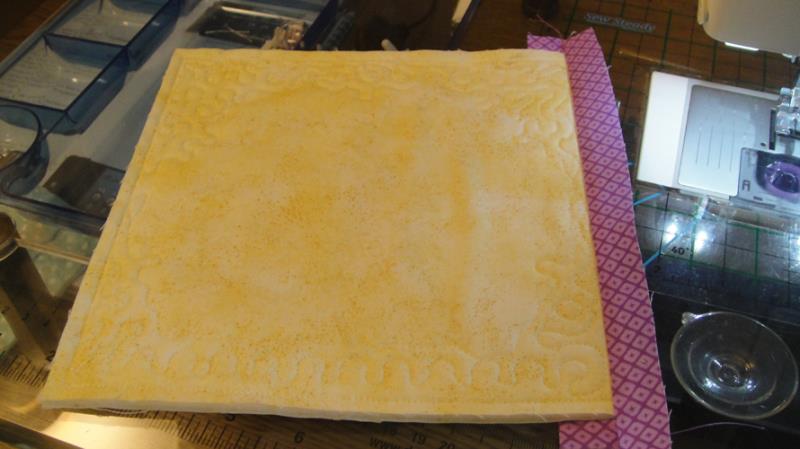
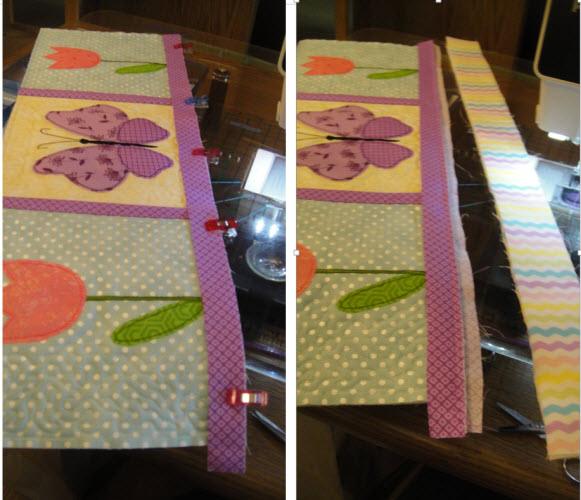
With craft clips align the raw edge of the folded 2” sashing strip to the front of the center block having the top and bottom edges exceed the side of the block by ½” on each end. At the same time, clip the 1” sashing strip to the back of the block right sides together.
Step 20:
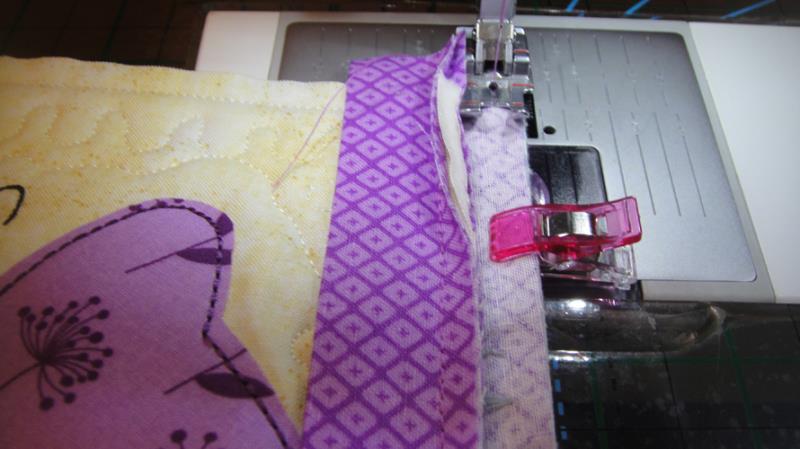
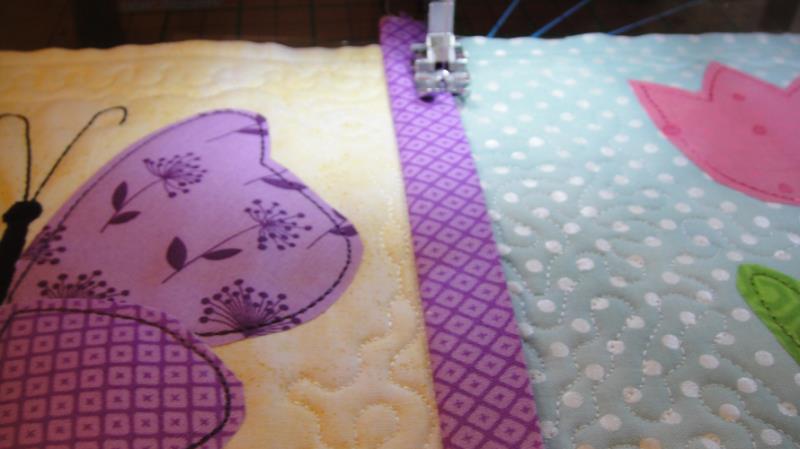
With a ¼” presser foot stitch an accurate ¼” seam through all layers. Stitching through all the thicknesses is easier with a 3mm stitch length. Use a thread in the top of the machine that matches your sashing strip and white thread or thread to correspond with the color of thread you used for your quilting stitches in the bobbin. In the sample lavender thread was used for both the top and bobbin thread.
(Click Image to Enlarge)
Step 21:
Press the 1” sashing strip on the back away from the block.
(Click Image to Enlarge)
Step 22:
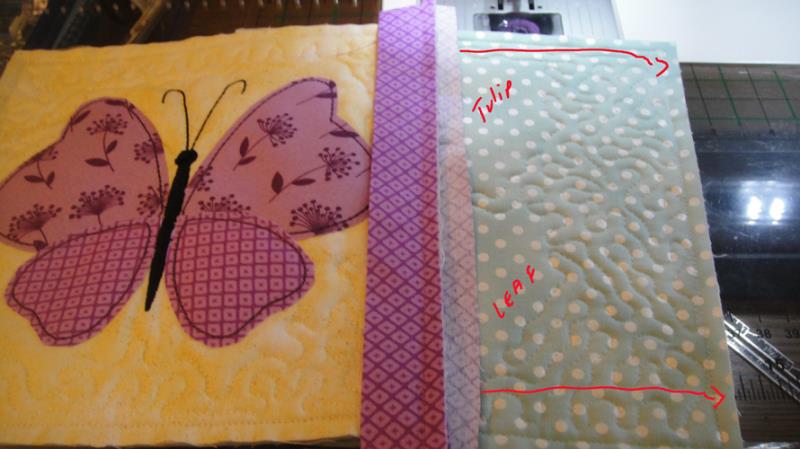
Place a Tulip block face down on the sewing machine, make sure the orientation is correct, i.e., the tulip blossom is to the top of the face down block. Place the raw edge of the 1” sashing to the right hand edge of the tulip block and clip in place aligning the top and bottom of the butterfly block and the tulip blocks.
(Click Image to Enlarge)
Step 23:
Stitch an accurate ¼” seam stitching the 1” sashing strip to the tulip block. You may have to lift the edge of the 1st seam to stitch this seam depending upon the shape of your 1/4” foot.
(Click Image to Enlarge)
Step 24:
When you open out the added block the seam allowances should just butt up to each other without gaps or overlaps. Press these seam flat to each other, then press the folded 2” sashing strips over the seam.
(Click Image to Enlarge)
Step 25:
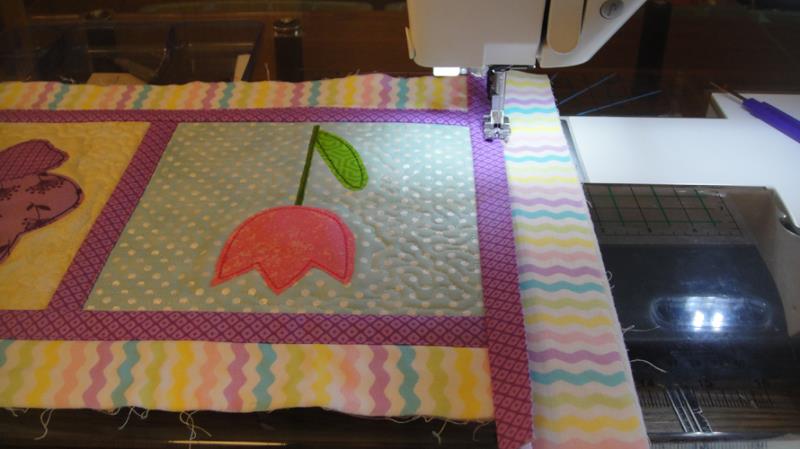
Edge stitch the sashing folded 2” sashing strip over the seam allowances.
(Click Image to Enlarge)
Step 26:
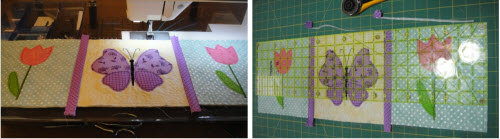
Join the second tulip block to the other side of the butterfly block following Step 18 through 25. Trim off the excess sashing from the top and bottom of the blocks.
Step 27:
Attach the sashing strips to the top and bottom edges of the table runner using the instructions in Steps 19 through 25 having about 1” of excess sashing and border on each end of the table runner.
(Click Image to Enlarge)
Step 28:
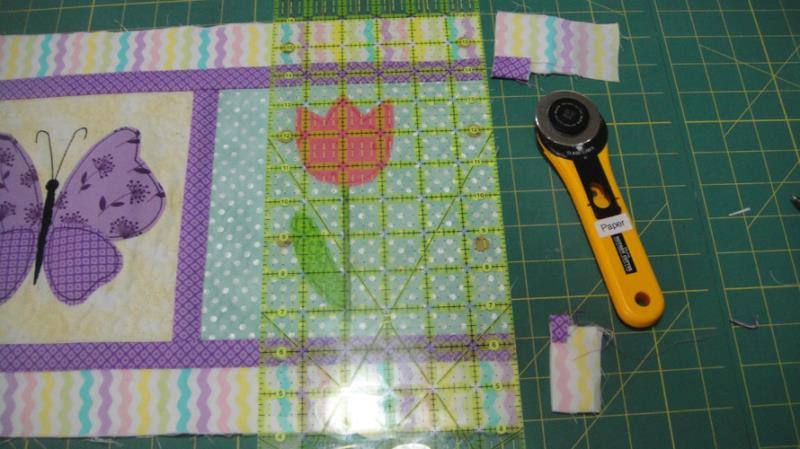
Trim the excess sashing and border from both ends of the table runner.
(Click Image to Enlarge)
Step 29:
Add the final side border strips using the techniques in Step 19 through 25 above.
(Click Image to Enlarge)
Step 30:
Trim the excess sashing and borders from the side borders. Bind as desired.
(Click Image to Enlarge)
Step 31:
Congratulations your Quick Spring Table Runner is complete!
Award winning Digitizer, Embroidery Educator, Author and a Consultant to the Industry, Pat Williams has 30 years of experience in the embroidery industry. Pat has won multiple awards for her digitizing expertise including the 2007 Impressions Awards Grand Championship, Best of Show as well as the 1st and 2nd Place Awards. Pat’s love of digitizing has afforded her the opportunity to write numerous articles for Impressions magazine in the United States and Images Magazine in Europe. In 2001 Pat was named “Embroidery Educator of the Year.” For many years Pat taught digitizing seminars at the ISS Shows in Long Beach, CA and for Compucon software. She now resides in Tucson, AZ.