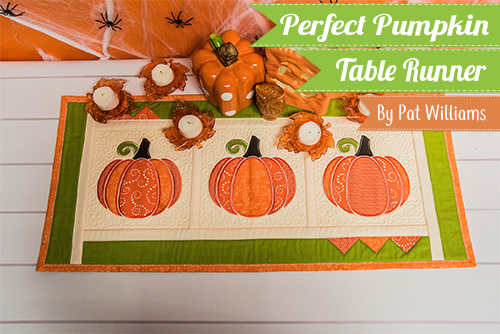
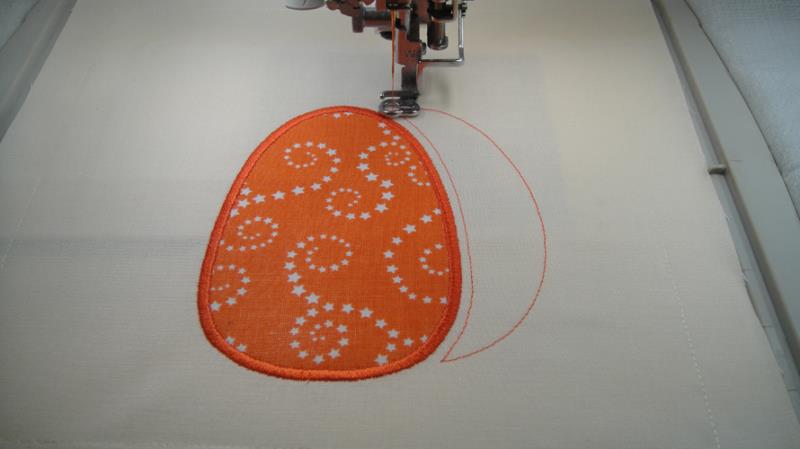
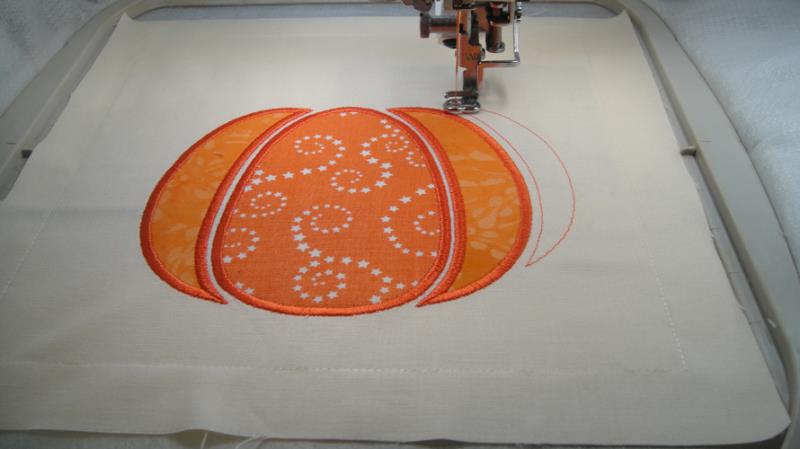
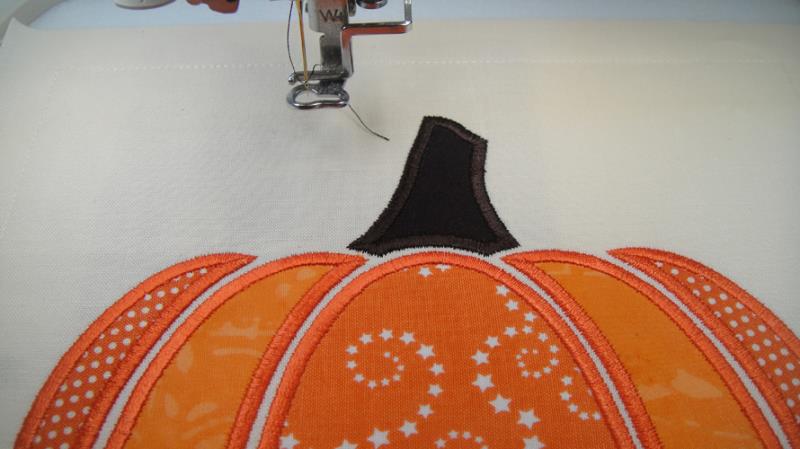
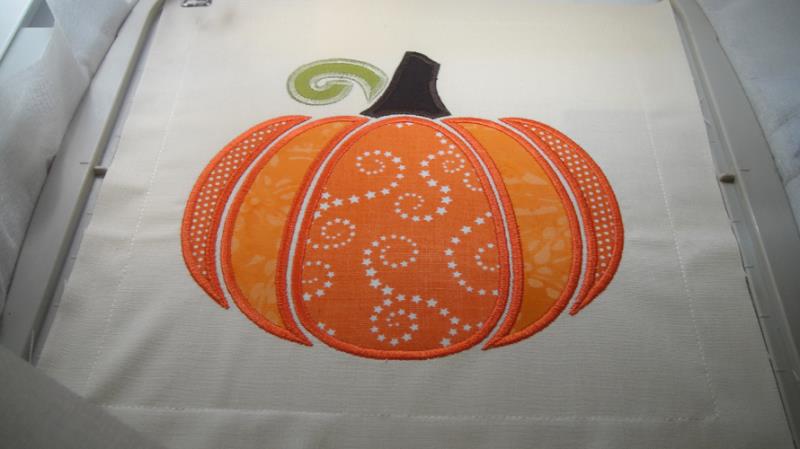
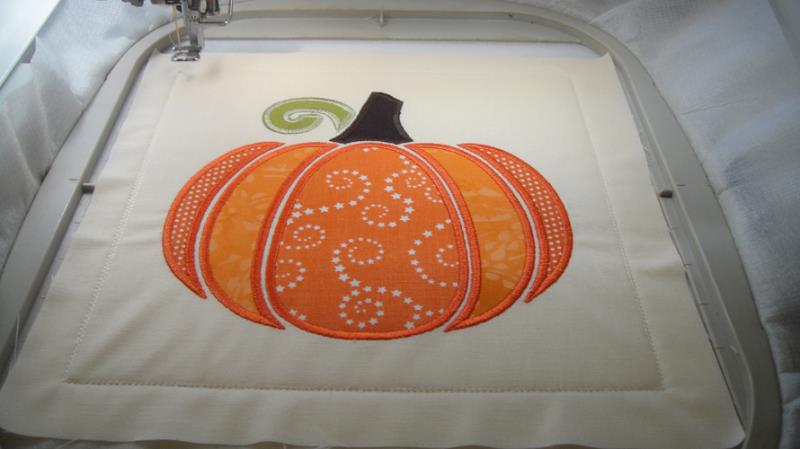
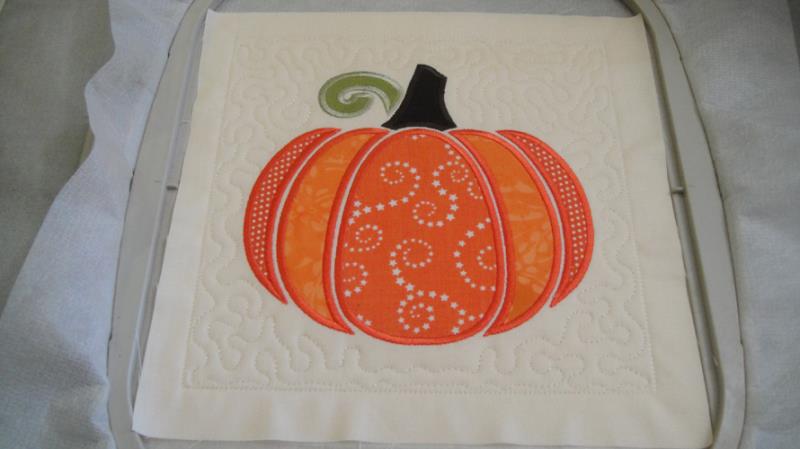
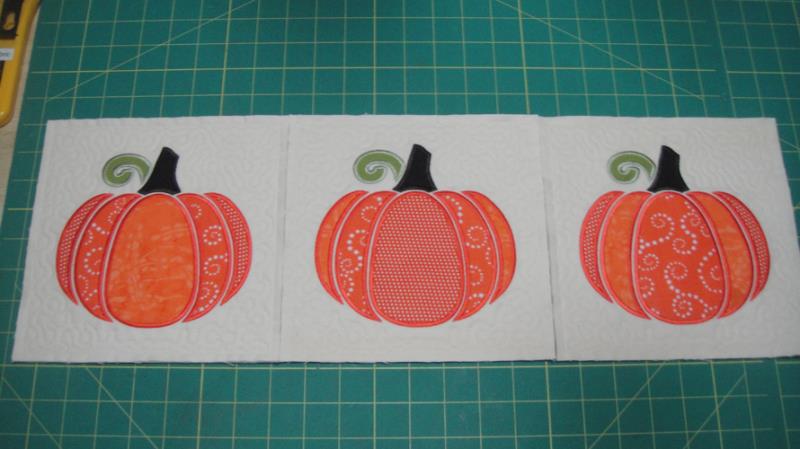
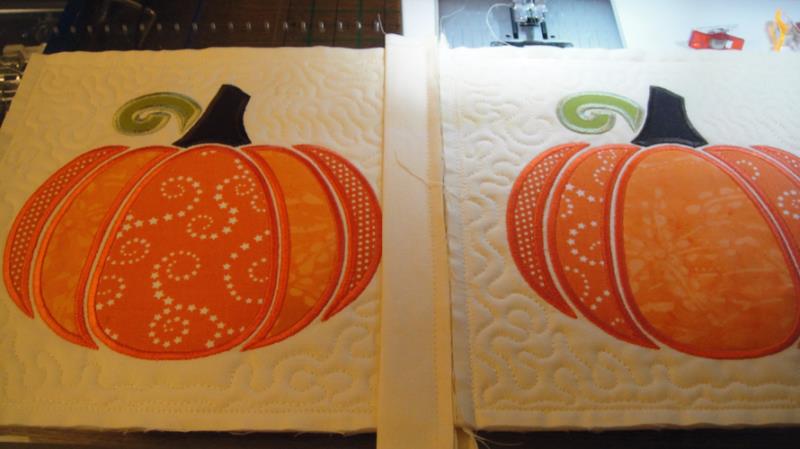
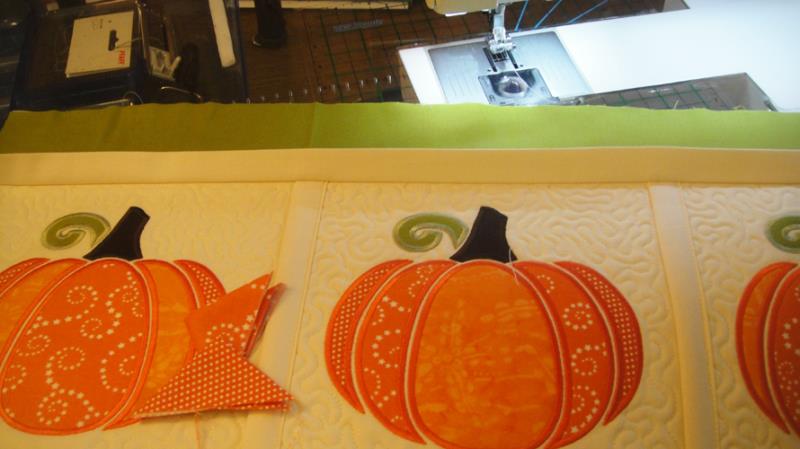
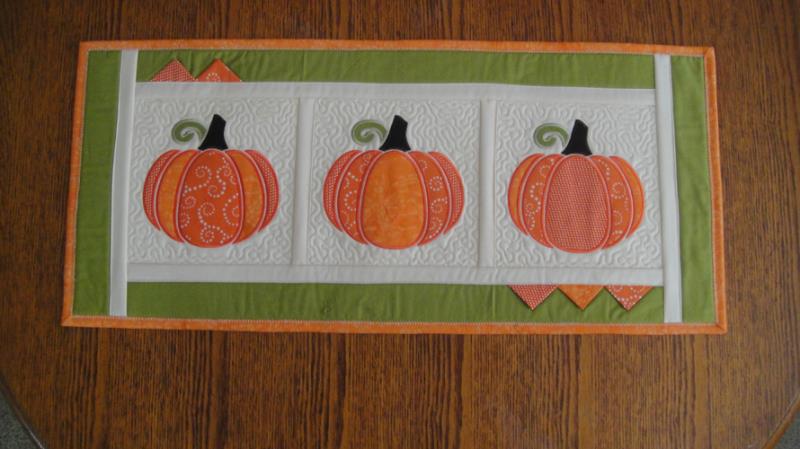
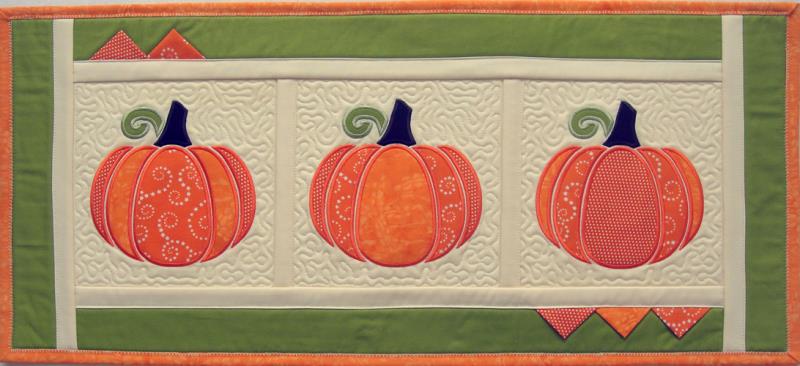
The three pumpkin blocks are all appliqued and quilted in the hoop. Simple sashing and borders complete this lovely table runner. The appliques may be precut or the stitch and trim method may be used.
The appliques shown in this project are precut with the Scan N Cut, however you may use the PDF files to manually precut the appliques or, the stitch and trim method may be used. If using the Scan N Cut® be sure to download the FCM files. The Scan N Cut® requires these in order for you to be able to move the segments of applique over the proper fabrics. SVG files are available for other cutters. If you are manually precutting your appliques, be sure to print the PDF file at 100%.
Two have the PDF, SVG or FCM files available to you select “All File Types” when you download the design. You will then select the embroidery format you want as well as the PDF, SVG or FCM files that you need.
Have a flat surface, such as a TV tray, covered with an ironing pad next to your embroidery machine. You will be removing the hoop from the machine many times to iron on appliques and place fabrics. As this embroidery area is large you will want to place your hoop on a flat surface each time to ensure that you do not loosen the stabilizer in the hoop.
Step 1:
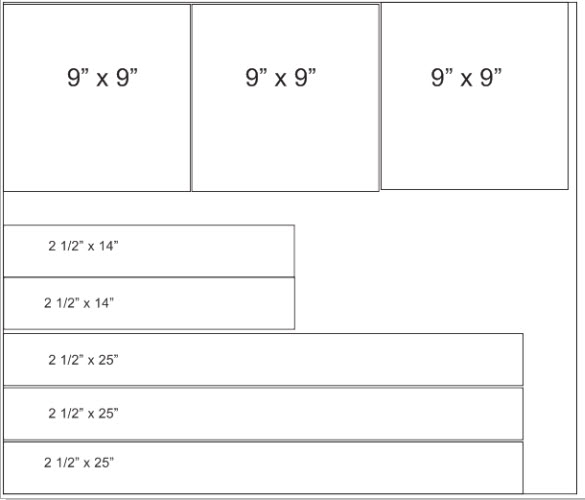
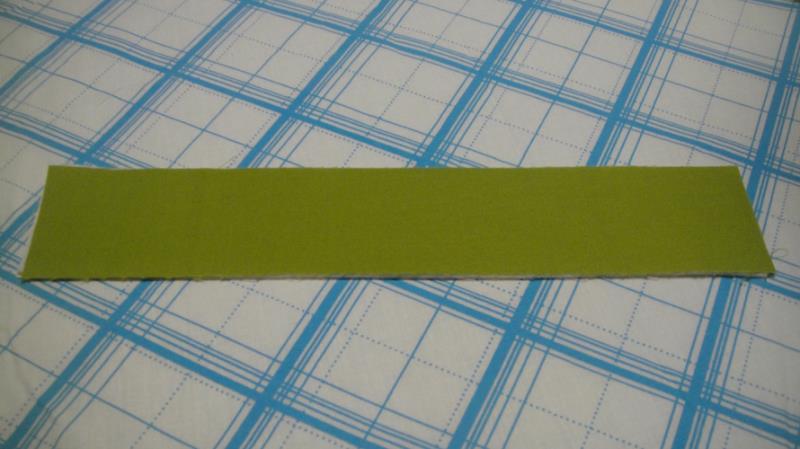
From the Battilizer® cut three 9” x 9” squares; 2 2 ½” x 25” rectangles and 2 2 ½” x 14” rectangles as shown in the photograph.
(Click Image to Enlarge)
Step 2:
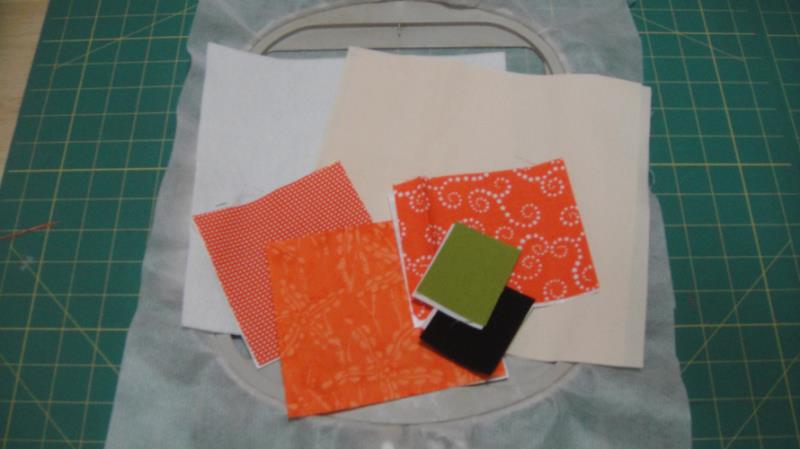
For each quilt block cut: a. 2 9” squares of cream fabric b. 1 5” x 4” rectangle of mandarin print for the center of the pumpkin c. 1 5” x 5 ½” rectangle of a mandarin print for the two middle sections of the pumpkin d. 1 4 ½ x 4 ½” rectangle of a mandarin print for the outside pumpkin sections e. 1 2 ½ x 2” rectangle of dark brown for the stem f. 1 2” x 2 ½” rectangle of olive green for the leaf Rotate the cutting of the mandarin color prints so a different fabric is used for the various sections of the pumpkins for each block.
(Click Image to Enlarge)
Step 3:
(Click Image to Enlarge)
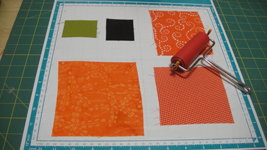
For all methods, press each applique fabric 4 times with Magic Sizing until the fabric is crisp, this helps prevent fraying when cutting the appliques. Cut Heat N Bond Lite® to the size of each applique rectangle and apply to the back of the fabrics following the manufacturer’s instructions. If using the Scan N Cut® remove the paper from the back of the rectangles and arrange on your cutting mat, roll with a brayer to make sure they will stay in place. If you mat is not holding the appliques wipe it with an alcohol free baby wipe and re-stick the mat with a Zig Two Way Jumbo Pen.
Step 4:
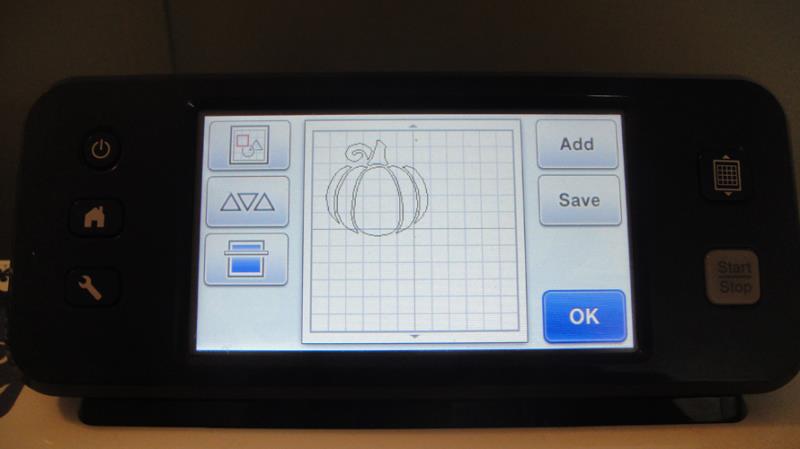
Open the FCM file in your Scan N Cut®.
(Click Image to Enlarge)
Step 5:
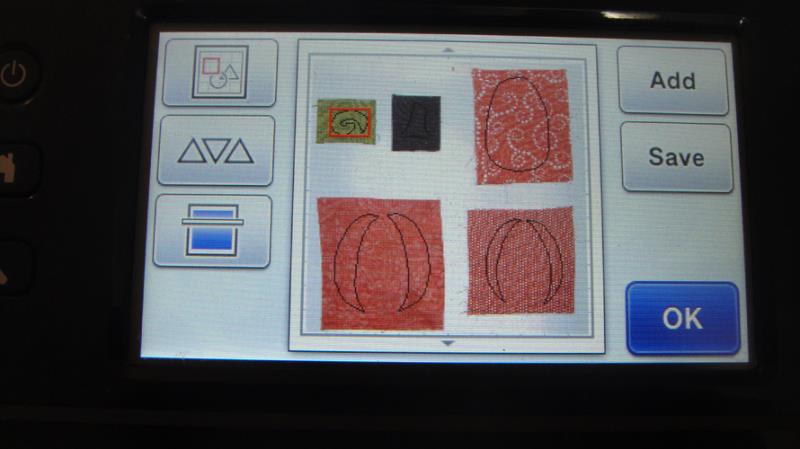
Scan in your mat and move the outlines of the applique pieces over the appropriate fabrics.
(Click Image to Enlarge)
Step 6:
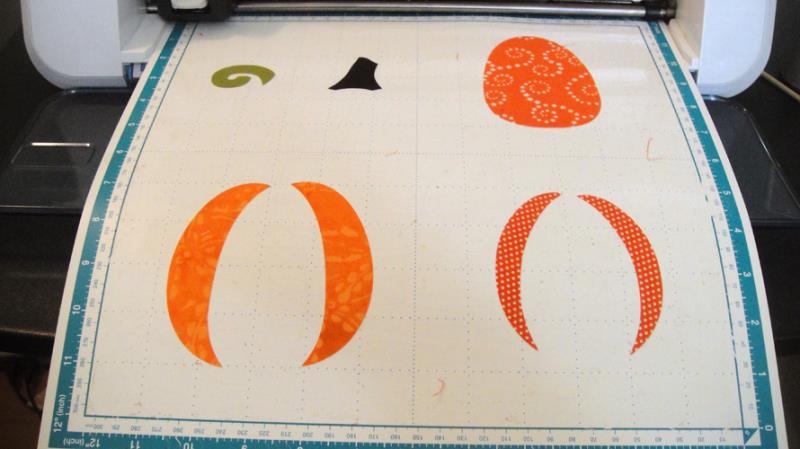
Cut the applique pieces. Due to the crescent shape of 4 of the segments leave the applique pieces on the mat until you are ready to use them. It will help you know which end is the top of each piece.
(Click Image to Enlarge)
Step 7:
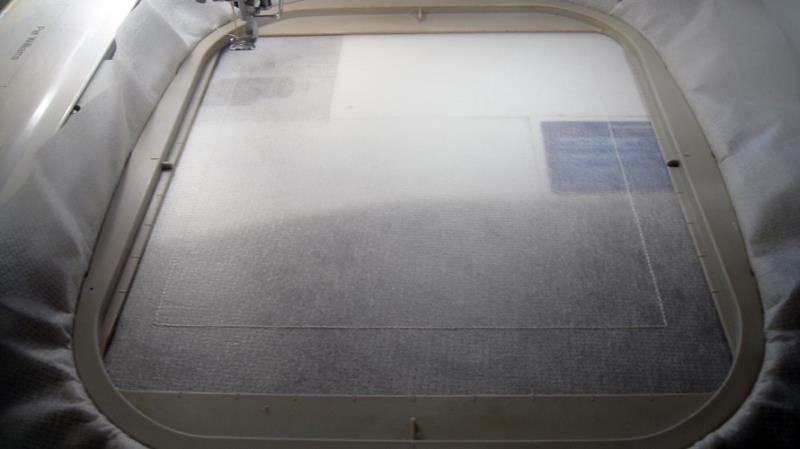
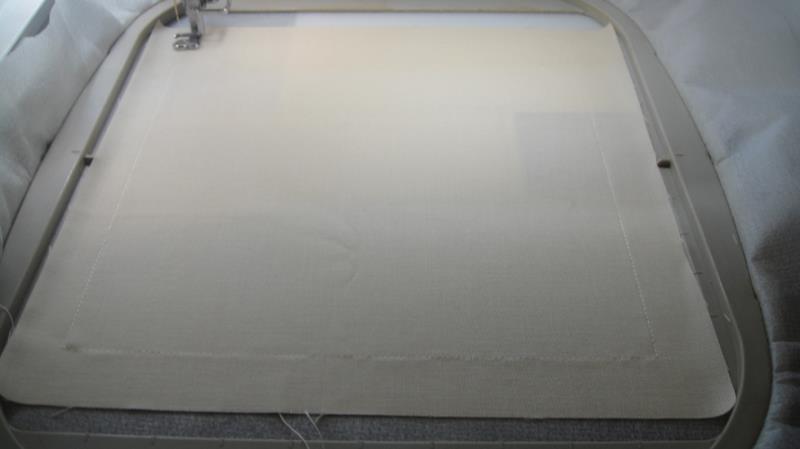
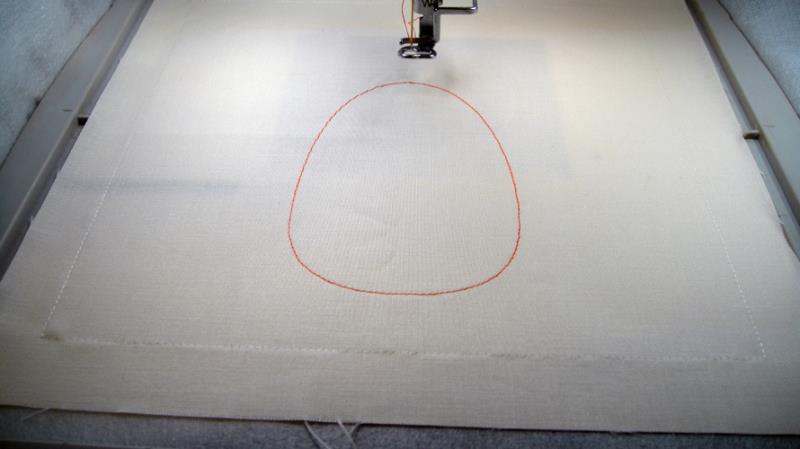
Hoop the no show stabilizer in your hoop and run color stop (CS) 1 in coconut cream as a placement line for your block fabric.
(Click Image to Enlarge)
Step 8:
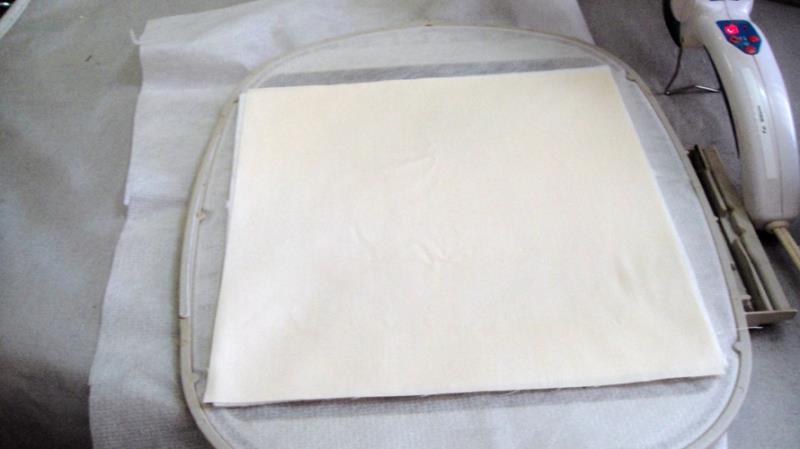
Remove the hoop from the machine and place on a flat surface. Spray adhesive on a 9” square of the cream fabric and position over the placement line so that the fabric exceeds the placement line by ½” on all sides. Return the hoop to the machine and tack down the fabric with water soluble thread in CS 2.
(Click Image to Enlarge)
Step 9:
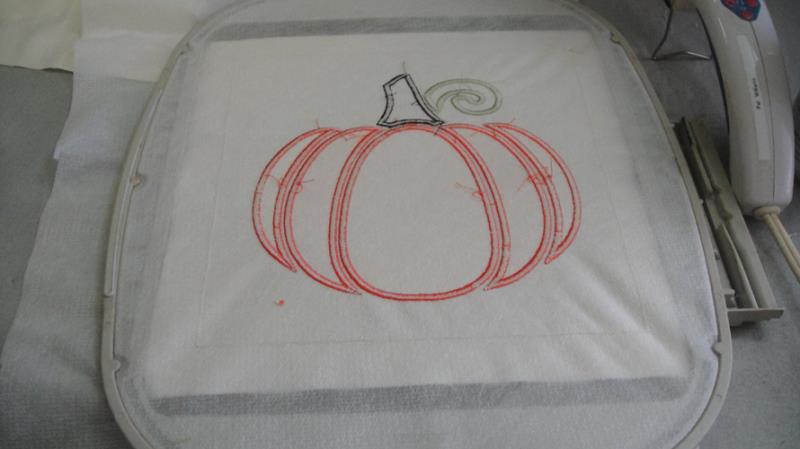
Run CS 3 in Mandarin thread or an orange thread that matches your fabrics as placement line for the center pumpkin section. Note this same thread color can be used for all of the color changes through CS 17.
(Click Image to Enlarge)
Step 10:
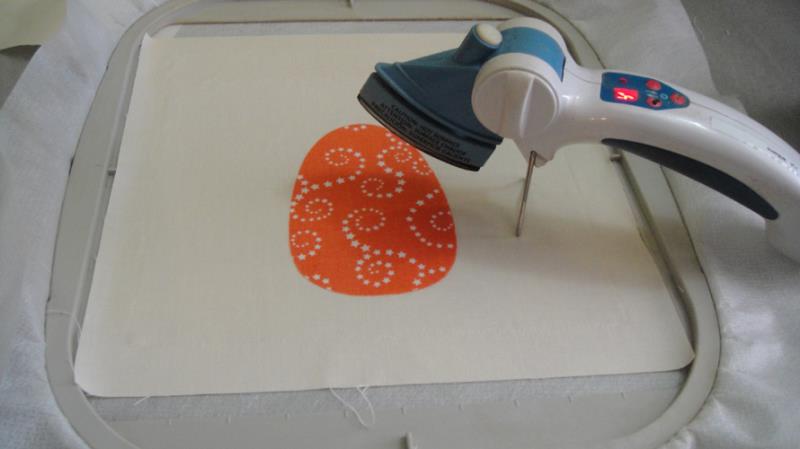
Remove the hoop from the machine and place on a flat surface. Position the center applique over the placement line and carefully iron the applique into place.
(Click Image to Enlarge)
Step 11:
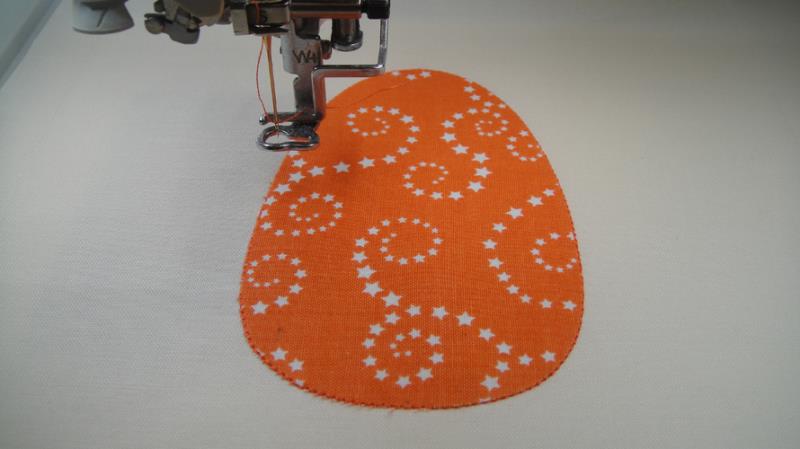
CS 4 is a tack down stitch for the applique. Technically it is not called for when using the precut applique method, but is needed by the people using the stitch and trim methods so that they can trim their appliques. Run it anyway as it will ensure you that your applique is in the proper position.
(Click Image to Enlarge)
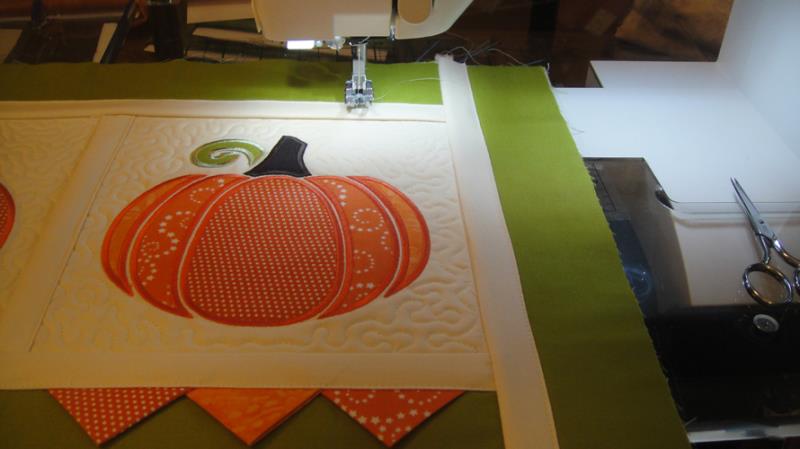
Step 12:
CS 5 will border your applique center applique and CS 6 will be the placement line for the second applique.
(Click Image to Enlarge)
Step 13:
Run CS 7 through 17 to stitch the remaining mandarin sections of the pumpkin continuing in the placement line, tack down and border sequence. Remove the hoop from the machine and lay on a flat surface for each applique to be ironed down.
(Click Image to Enlarge)
Step 14:
For CS 18, 19 and 20 switch to Chocolate Chip (1130) for the placement line, tack down and border of the stem.
(Click Image to Enlarge)
Step 15:
Run CS 21, 22 and 23 in Weeping Willow (1105) for the placement line, tack down and border of the stem.
(Click Image to Enlarge)
Step 16:
Remove the hoop from the machine, do not unhoop, lay the hoop down face down on a flat surface.
(Click Image to Enlarge)
Step 17:
Spray adhesive on a 9” square of Battilizer® and place on the back of the hoop aligning it with the fabric that is on the front of the hoop. Spray adhesive on the quilt block back fabric and place it over the Battilizer®.
(Click Image to Enlarge)
Step 18:
Return the hoop to the machine. Make sure the fabric and Battilizer® added to the back of the hoop are smooth under the hoop. Run CS 24 in water soluble thread to tack down all of the fabrics.
(Click Image to Enlarge)
Step 19:
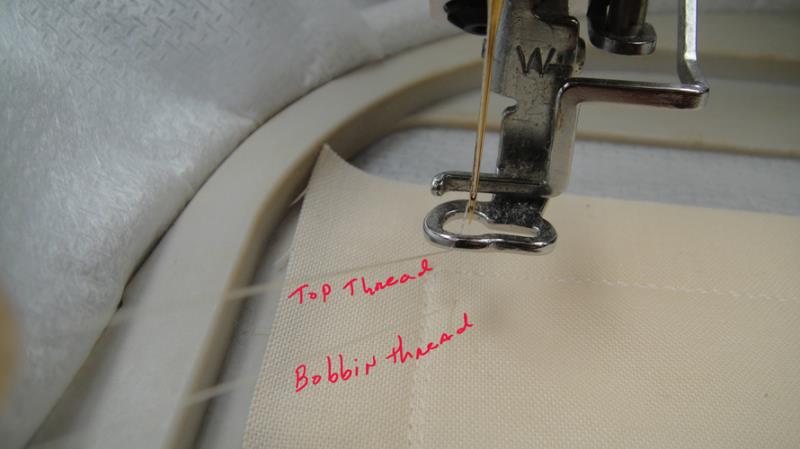
Change the top and bobbin threads to the colors you want for the quilting. In this case I used Coconut Cream (1072). To avoid messy tie-down stitches on the back of your work feed the top thread through the presser foot; hold the top thread in your left hand; hit the needle-up button twice on the machine; this will lift the bobbin thread to the top of your work. Pull the bobbin thread out to meet the length of the top thread. Holding onto both threads stitch a few stitches until the needle has moved away from the start point.
(Click Image to Enlarge)
Step 20:
Stop the machine and trim off the two thread tails then commence sewing the rest of the quilting.
(Click Image to Enlarge)
Step 21:
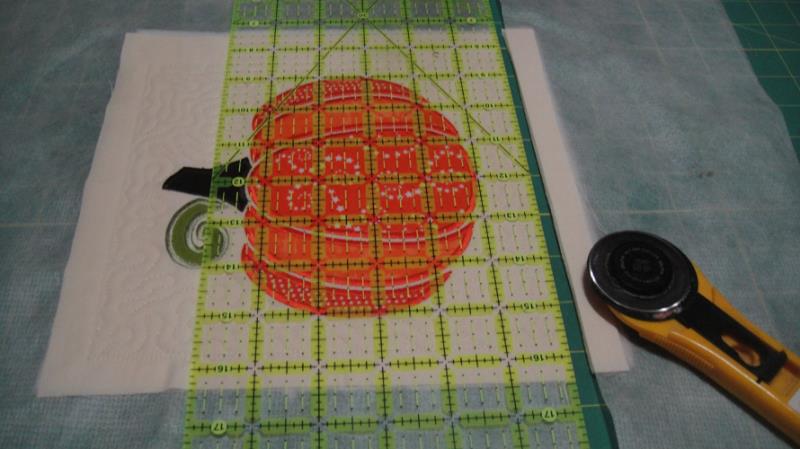
Align the ¼” mark of a see through ruler along the water soluble thread lines of the quilt block and trim all edges to a ¼” seam allowance.
(Click Image to Enlarge)
Step 22:
Make two more Perfect Pumpkin blocks using the above Steps.
(Click Image to Enlarge)
Step 23:
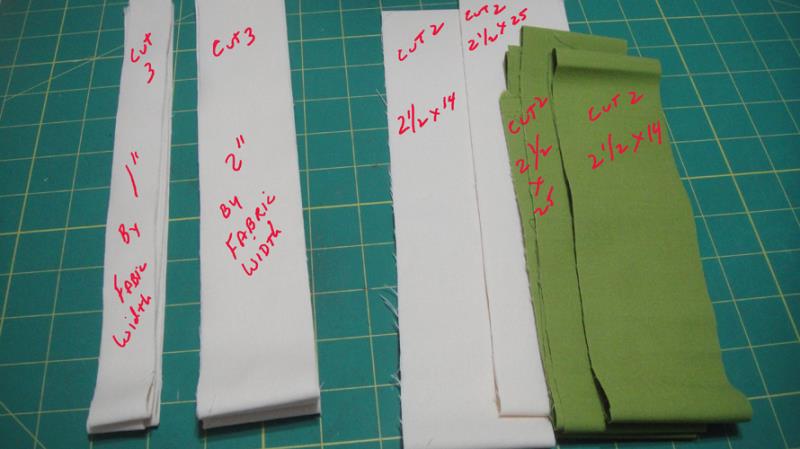
Cut 3 1” strips and 3 2” strips of cream fabric for sashing. Cut 2 2 ½” x 14” and 2 2 ½” x 25” rectangles of cream for border backs; cut 2 2 ½” x 14” and 2 2 ½” x 25” rectangles of olive green for the front borders. You should already have Battilizer® cut for the borders from Step 1.
(Click Image to Enlarge)
Step 24:
Spray adhesive on one side of the Battilizer® for a border strip, align the back border piece and smooth over the Battilizer®. Turn the strip over, spray the olive green strip and adhere to the front side of the Battilizer® creating a quilt sandwich. Do this for all 4 border sections.
(Click Image to Enlarge)
Step 25:
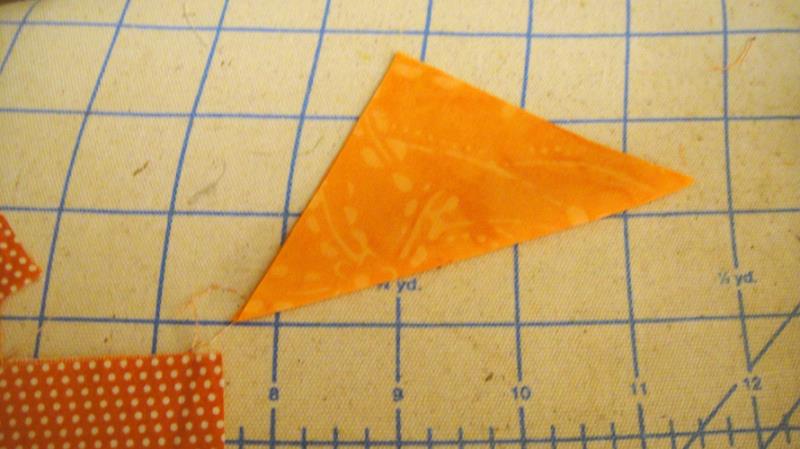
Cut 5 3” squares from the mandarin fabrics for the prairie points. Fold in half diagonally and press.
(Click Image to Enlarge)
Step 26:
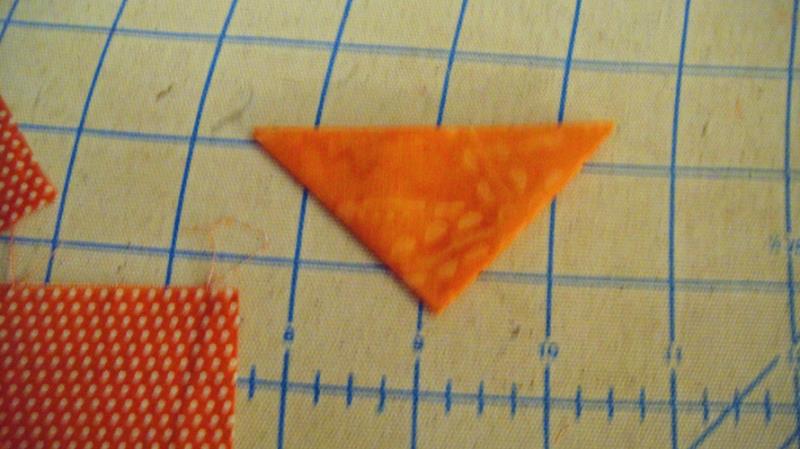
Fold in half again and press to form the prairie points. All the raw edges should be even at the bottom of the prairie point. While at the iron fold the 2” sashing strips in half lengthwise and press.
(Click Image to Enlarge)
Step 27:
(Click Image to Enlarge)
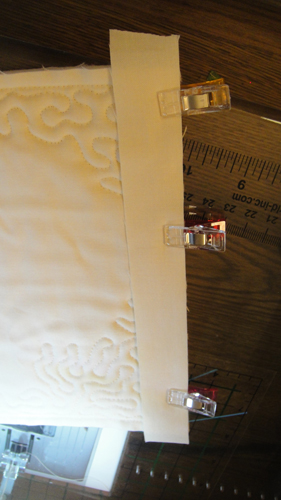
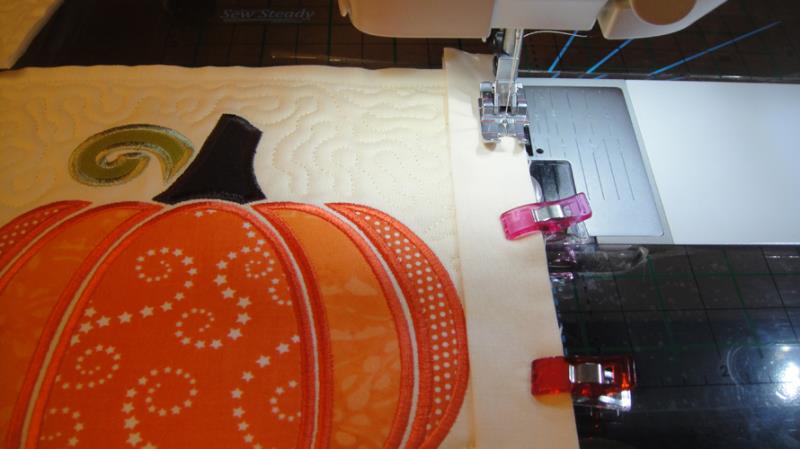
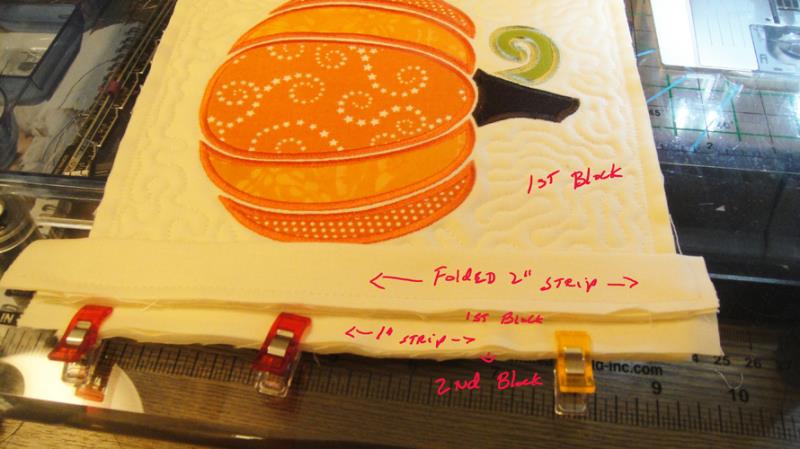
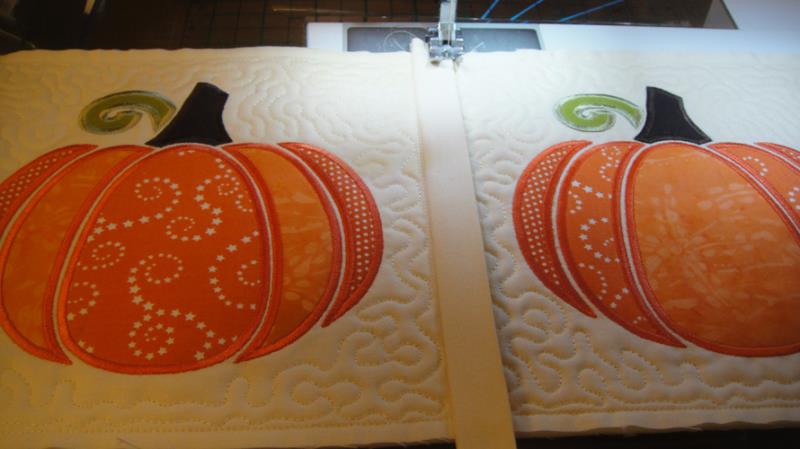
We are going to stitch the 1” sashing strip and the folded 2” sashing strip to the right side edge of the 1st quilt block all in one seam. To do this align a side edge of the 1” sashing strip along the right hand edge of the back of the 1st block having the ends of the sashing strip extend ½” above the top and bottom of the block, clip in place. At the same time align the lengthwise raw edges of the folded 2” strip on the front of the block having the ends of the strip extend beyond the top and bottom of the block approximately ½”; clip in place.
Step 28:
With a 3mm stitch length, a walking foot attached in possible, stitch an accurate ¼” seam stitching the top and bottom sashing strips to the block.
(Click Image to Enlarge)
Step 29:
(Click Image to Enlarge)
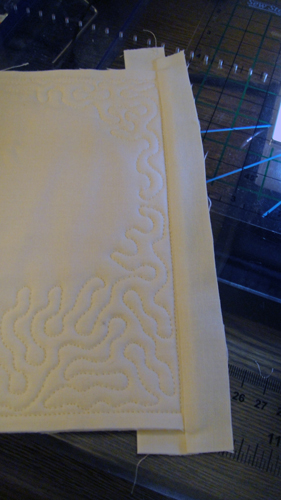
Press the 1” back sashing strip away from the block.
Step 30:
Lay the first block with the sashing stitched on right side up. Slide the 2nd block underneath the first one right side down. Align the 1” sashing strip along the side of the bottom block, make sure the tops and bottoms of the blocks are aligned at the same time. Clip the 1” strip to the 2nd block.
(Click Image to Enlarge)
Step 31:
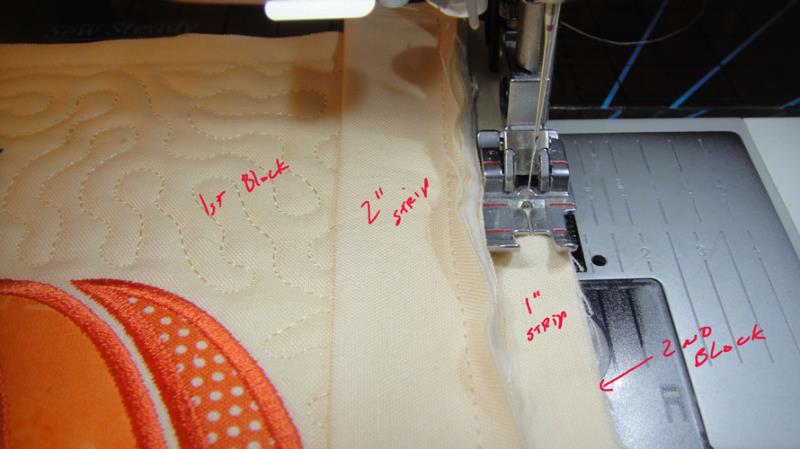
With an accurate ¼” seam stitch the 1” strip to the back block. You may have to lift the 1st seam a little to get the presser foot slightly under it while stitching this seam.
(Click Image to Enlarge)
Step 32:
Open out the two blocks. The two seam allowances should butt up to each other without overlaps or gaps.
(Click Image to Enlarge)
Step 33:
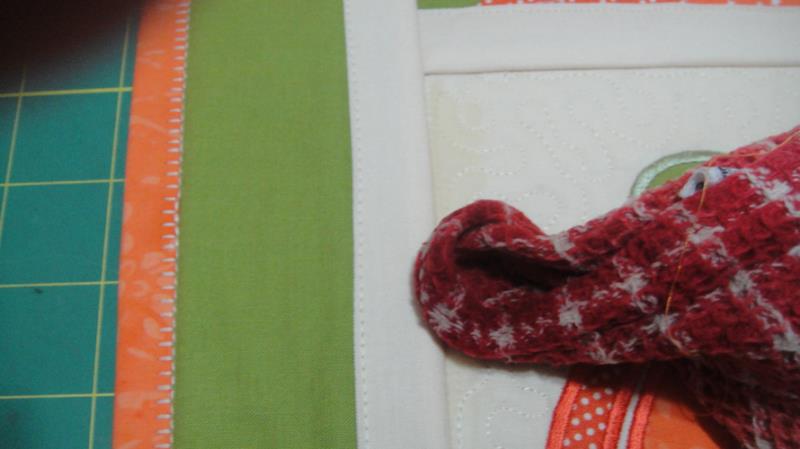
Press the folded 2” sashing over the seams. Stitch down through all layers along the right hand edge.
(Click Image to Enlarge)
Step 34:
(Click Image to Enlarge)
Attach the 3rd block to the 2nd block by attaching the two sashing strips to the 2nd block as in Step 30; stitch the 1” bottom strip to the 3rd block as in Step 31; press over the folded sashing and edge stitch as in Step 33.
Step 35:
(Click Image to Enlarge)
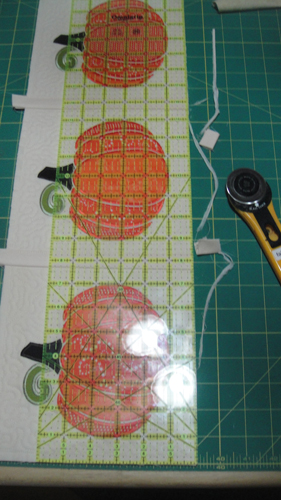
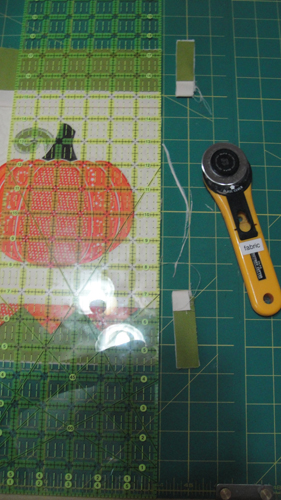
Trim off the excess sashing at the top and bottom of the blocks squaring up the row of blocks at the same time.
Step 36:
The long border pieces are now attached to the quilted blocks in the same manner. Clip a 1” border to the back top edge of the quilted block row having the ends extend beyond the row of blocks by ½” on each end. Clip the 2” folded sashing strip to the front of the row having the raw edges even across the top and having the ends extend beyond the ends of the row by ½”. Stitch together with a 1/4” seam allowance; press out the 1” sashing strip. Place the 1” sashing strip along the edge of the back of the border strip, the border strip will also be about ½” longer than the quilted row at each end. Stitch the 1” sashing to the border. Open out the border and press the folded sashing over the seam allowances. However there is one extra step before you topstitch down the top sashing.
(Click Image to Enlarge)
Step 37:
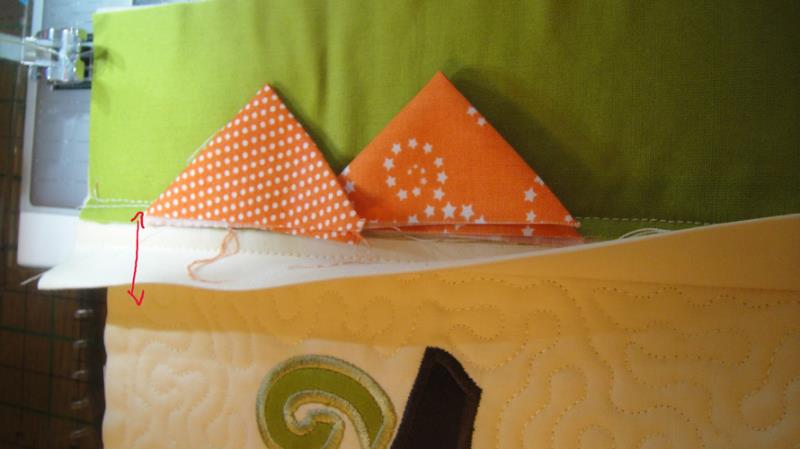
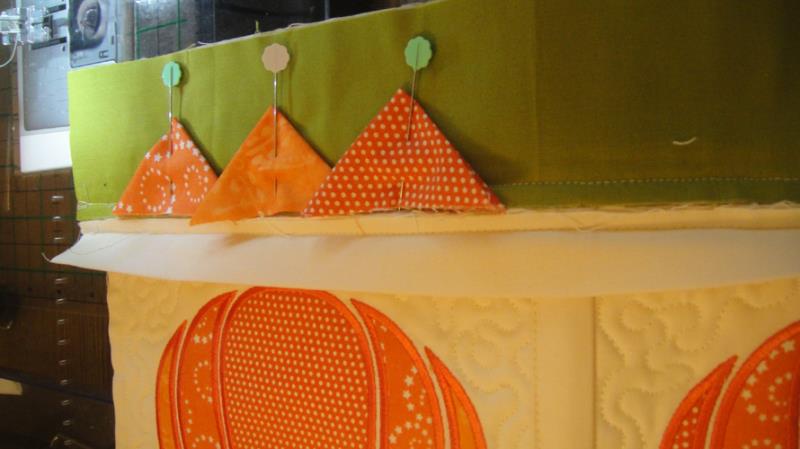
Pick two of the 5 prairie points. Place the 1st one so its left hand edge is about ½” from the outside edge of the quilted row; overlap the ends of the 2nd prairie point aligning the bottom of the prairie points with the ¼” seam allowance. Pin in place. Fold over the top sashing strip over the border and prairie points and edgestitch.
(Click Image to Enlarge)
Step 38:
Attach the sashings to the front and back of the bottom edge of the row; press out the 1” strip and stitch to the bottom border; press out the 1” border. Open out the bottom border and place three prairie points to about ½” from the outside edge of the quilted row, press over the top sashing and edge stitch.
(Click Image to Enlarge)
Step 39:
(Click Image to Enlarge)
Trim off the excess border and sashing strips along the side edges squaring up your table runner if necessary.
Step 40:
Attach the side borders as you did the top and bottom borders without the addition of prairie points. Trim the excess border and sashing strips.
(Click Image to Enlarge)
Step 41:
Cut 3 2 ¼” strips of binding fabric and bind as desired.
(Click Image to Enlarge)
Step 42:
If any of the original and final tack down lines sewn in water soluble thread are visible they can be removed with the corner of a wet cloth or sponge. Be sure to pull out and trim off any bobbin threads associated with those tack down lines on the back of the table runner.
(Click Image to Enlarge)
Step 43:
Congratulations your Perfect Pumpkin Table Runner is complete!
Award winning Digitizer, Embroidery Educator, Author and a Consultant to the Industry, Pat Williams has 30 years of experience in the embroidery industry. Pat has won multiple awards for her digitizing expertise including the 2007 Impressions Awards Grand Championship, Best of Show as well as the 1st and 2nd Place Awards. Pat’s love of digitizing has afforded her the opportunity to write numerous articles for Impressions magazine in the United States and Images Magazine in Europe. In 2001 Pat was named “Embroidery Educator of the Year.” For many years Pat taught digitizing seminars at the ISS Shows in Long Beach, CA and for Compucon software. She now resides in Tucson, AZ.